
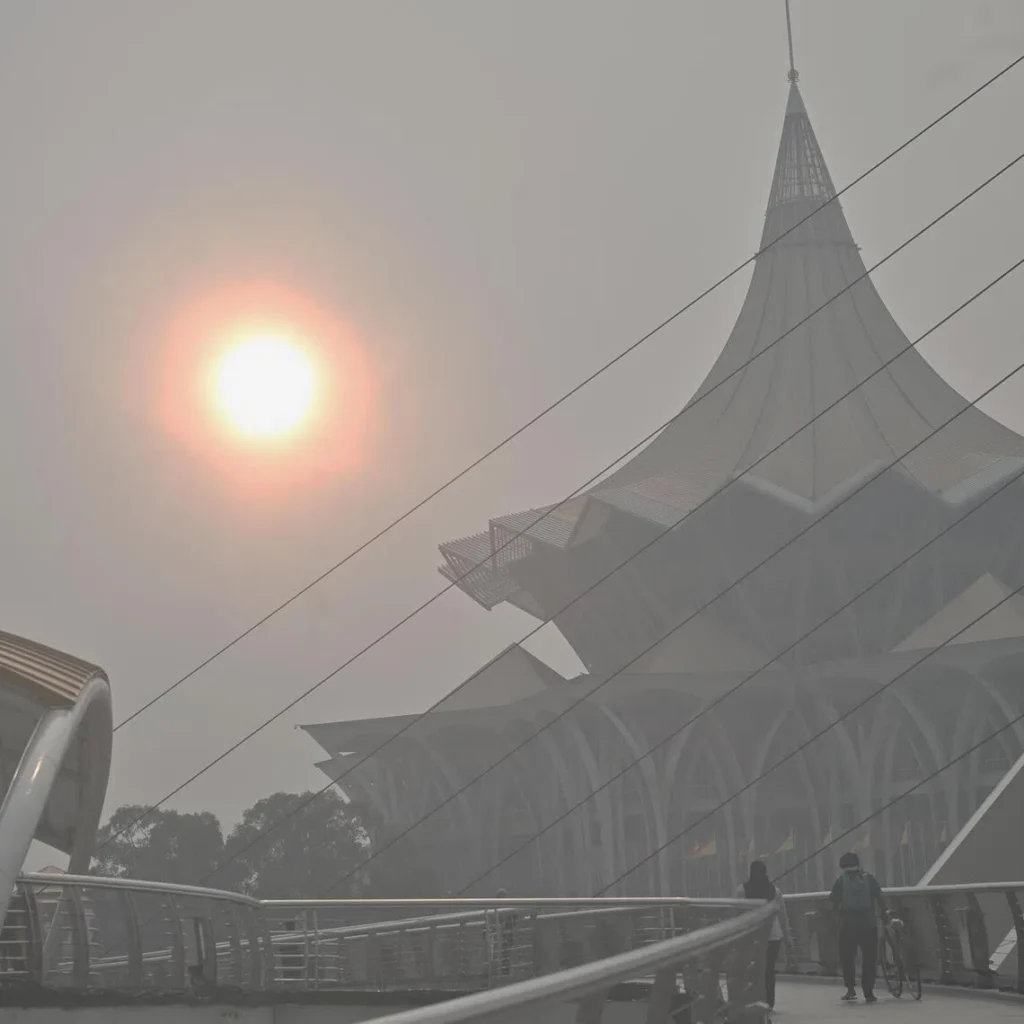
Sarawak under haze: Smoke from fires in neighbouring Indonesia has reduced visibility across parts of Sarawak, highlighting the health and environmental consequences of transboundary air pollution. For communities living near the West Kalimantan border, the annual haze is more than an environmental concern — it affects the air they breathe, outdoor activities and the health of vulnerable residents.
As I write this, the television in the room is carrying another update on Malaysia’s worsening haze situation. The newscaster says: “591 Sarawak schools to remain closed tomorrow over unhealthy air quality”.
I live about 25 miles north of the West Kalimantan border, so news of fires across the border feels different from reading about fires in a distant part of Indonesia. The two places are on the same island, and what happens in one can affect people living in the other.
The haze has become familiar in this region. When air quality deteriorates, people start checking the readings, wondering whether children should be outdoors and whether older people or those with respiratory problems should take extra precautions.
We have been through this many times before. That is perhaps what is most troubling.

The latest fires in West Kalimantan are again sending smoke into parts of Sarawak, West Malaysia and Singapore while regional weather conditions can carry pollution much farther.
The immediate concern is air quality, but the underlying problem is much bigger.
Haze is a mixture of fine particles and gases produced by burning vegetation, forests and, in some areas, peatlands. The health effects depend on what is burning, how intense the fires are, how long they continue and how pollutants disperse in the atmosphere.
The science matters because it tells us what we are actually breathing.
What exactly are we breathing?
PM2.5 — fine particles measuring 2.5 micrometres or less — is among the pollutants of greatest concern because these particles can penetrate deep into the lungs. Some can enter the bloodstream.
High or prolonged exposure can worsen respiratory and cardiovascular problems, particularly among children, older people and those with existing health conditions.
So when television reports say the haze is worsening, it is not simply reporting a change in visibility.
It is reporting a change in the quality of the air people are breathing.
There is also no single cause of Indonesia’s annual fires. Some are linked to land clearing and agricultural practices, where burning can be cheaper and faster than mechanical clearing.
The problem becomes more serious when fire reaches peatland.
Peat consists largely of partially decomposed organic material accumulated over long periods under waterlogged conditions. When peatlands are drained or become unusually dry, they can become highly vulnerable to fire.
Peat fires can burn below the surface and continue smouldering even when there are few visible flames. They can be difficult to locate and extinguish and can produce large quantities of smoke and carbon.
What happens after the smoke rises?
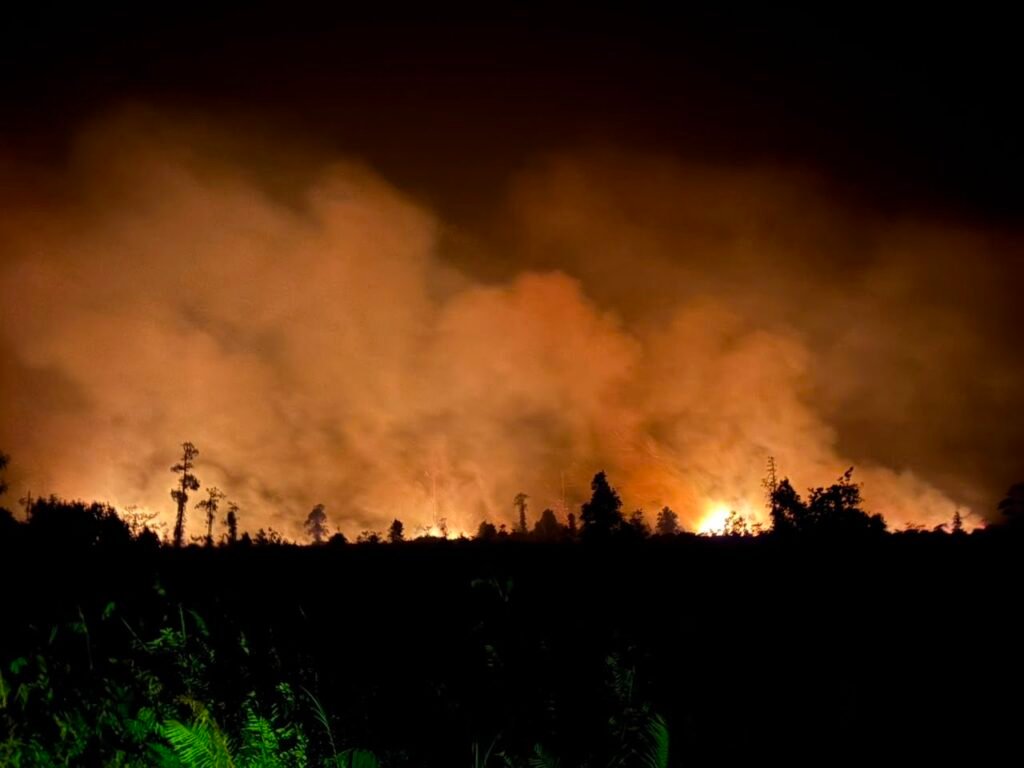
Indonesia is at the peak of its annual fire season, with West Kalimantan accounting for more than half of the nearly 49,000 hectares (121,000 acres) burned across six priority provinces as of Aug. 9.
Once smoke enters the atmosphere, weather becomes a major factor.
Wind direction and speed, rainfall, humidity, temperature and atmospheric stability influence how far pollutants travel and how concentrated they become.
This explains why one community may experience relatively good air quality while another, not necessarily much closer to the fire, experiences a significant deterioration.
For Sarawak, the geographical relationship with West Kalimantan makes this particularly important.
The border divides two countries on the same island, but the forests, rivers and atmospheric systems of Borneo do not follow political boundaries.
Pollution generated on one side can affect people on the other.
That makes transboundary haze fundamentally different from an ordinary local pollution problem.
Sarawak can monitor its own air and take measures to protect its population. But it cannot control every fire burning across the border.
The health cost
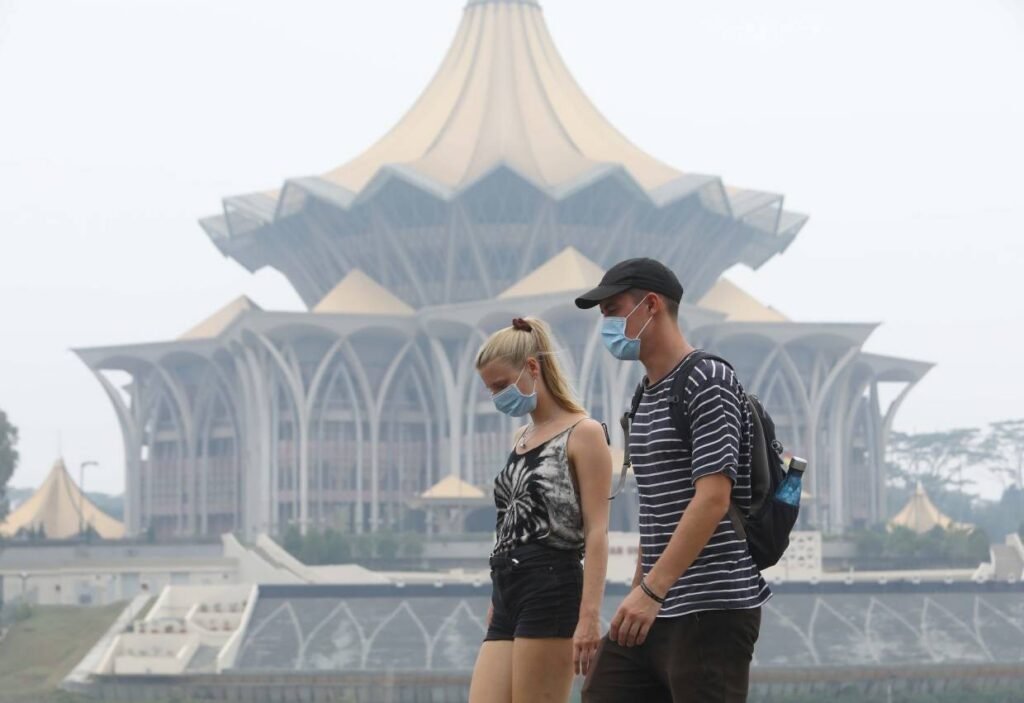
A couple wear masks as they make their way through smoke-affected conditions in Sarawak. The fine particles in haze, particularly PM2.5, can penetrate deep into the lungs and pose health risks, especially with prolonged exposure.
Haze is often discussed in terms of visibility. That can be misleading. The pollutants that matter most for health are not necessarily the ones that can be seen.
PM2.5 is particularly concerning because the particles are small enough to travel deep into the respiratory system. Exposure can aggravate asthma and other respiratory conditions and increase risks for people with existing heart and lung problems.
This is why a haze advisory is not merely an inconvenience.
When authorities advise people to reduce strenuous outdoor activity or keep vulnerable individuals indoors, they are responding to a genuine public-health concern.
There are economic consequences as well.
Poor air quality can affect tourism, outdoor work, schools, businesses and transport. Severe haze can disrupt aviation when visibility falls and make road travel more hazardous.
The people carrying these costs may be hundreds of kilometres from where the fire began.
ASEAN has known this for years
Southeast Asia has been discussing this problem for decades.
The ASEAN Agreement on Transboundary Haze Pollution was adopted in 2002, recognising that land and forest fires could produce consequences beyond national borders.
Yet more than two decades later, haze continues to return.
The problem is not a lack of scientific understanding. It is the difficulty of translating regional commitments into consistent prevention, enforcement and land-management practices.
ASEAN’s principle of non-interference also complicates matters. Member states cooperate, but national governments retain primary authority over activities within their own territories.
Malaysia can complain about pollution crossing the border. Indonesia can point to its efforts to prevent and control fires. ASEAN can call for cooperation.
Meanwhile, communities continue breathing the smoke.
We have the technology
This is not a problem for which we lack scientific tools. Satellites can identify hotspots. Remote-sensing technology can monitor land cover. Weather models can help predict where smoke may travel. Ground stations can measure particulate pollution.
But technology can only identify a problem.
A satellite can detect a fire. It cannot prevent someone from starting it. A monitoring station can record rising PM2.5 levels. It cannot remove the pollution.
A weather model can predict where smoke may travel. It cannot stop the fire producing it. The missing ingredient is often not information. It is action.
Prevention must come first
The most effective haze policy is not an emergency response after the smoke has crossed the border. It is prevention.
That means monitoring fire-prone areas before the dry season becomes critical, maintaining healthy peatlands, detecting fires quickly and responding before they spread.
It also means addressing the economic reasons why burning is used for land clearing.
Telling small farmers not to burn without providing affordable alternatives is unlikely to solve the problem. At the same time, companies operating in fire-prone landscapes must be held responsible where negligence or illegal practices contribute to fires.
The objective should be to make responsible land management more practical and burning less attractive.
The science is clear. The pollution is measurable. The health risks are documented. The technology exists.
What remains uncertain is whether Southeast Asia will finally treat haze prevention as a permanent regional responsibility rather than a seasonal emergency.
That is a political choice, not a scientific mystery.