

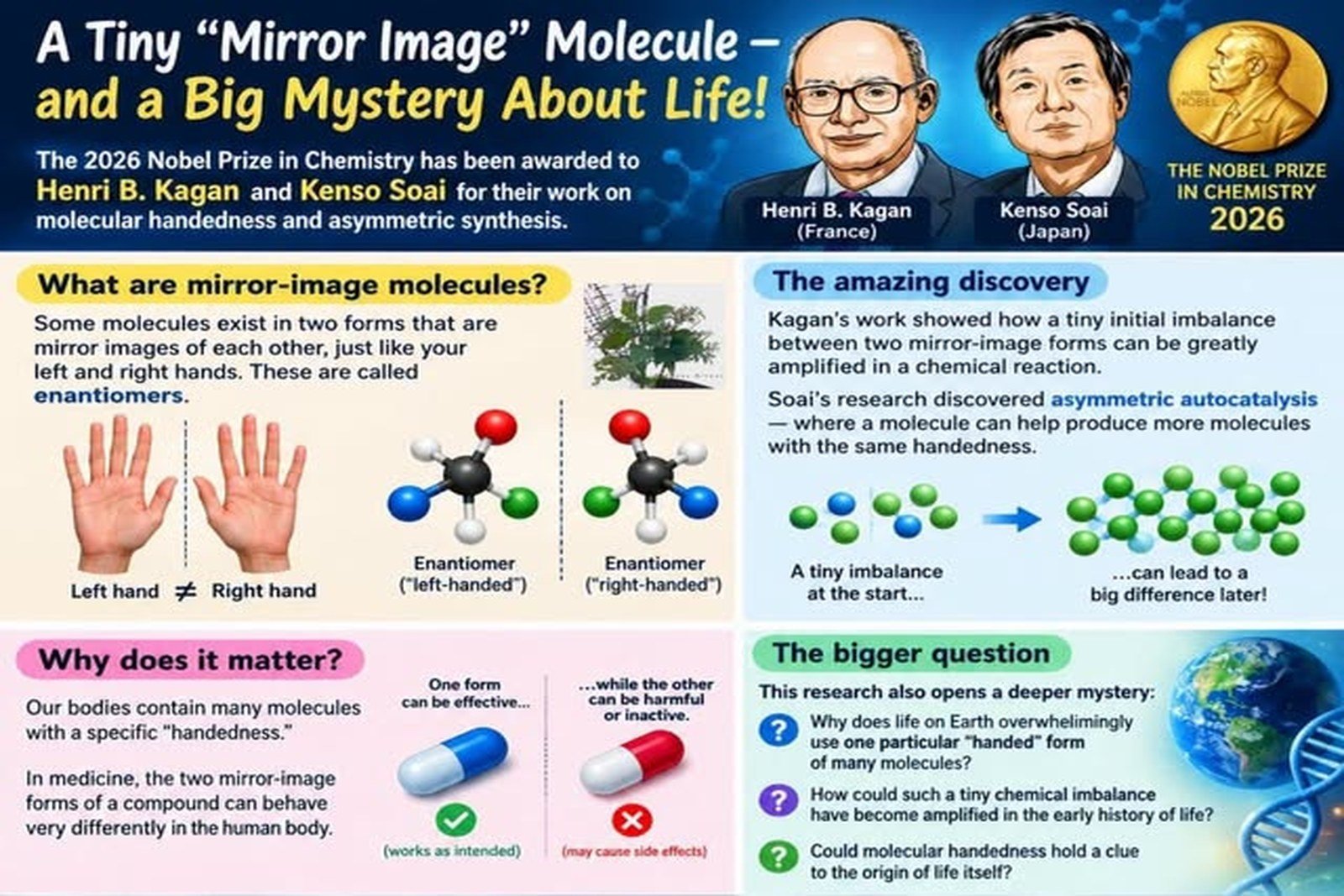
Have you ever looked at your two hands and noticed something interesting? They look almost identical, yet your left hand cannot be perfectly superimposed on your right. Chemistry has a similar phenomenon, only on a microscopic scale.
Many of the molecules that make life possible, from DNA to the amino acids that build proteins, have a distinct handedness. Scientists call this property chirality. A molecule may exist in two forms that are mirror images of each other but cannot be superimposed, much like our left and right hands.
For decades, controlling this molecular handedness in the laboratory presented one of organic chemistry’s most difficult challenges. Today, advances in asymmetric synthesis and autocatalysis have transformed how scientists approach the problem.
The pioneering contributions of French chemist Henri B. Kagan and Japanese chemist Kenso Soai have helped chemists understand how to control, and even amplify, molecular handedness. Their work has implications for medicine, chemical manufacturing and one of science’s most intriguing questions: how did life develop its preference for particular molecular forms?
Why a Molecule’s Handedness Matters

Molecular handedness is more than a fascinating scientific curiosity. It can determine how a substance behaves inside the human body.
In pharmaceutical chemistry, two mirror-image forms of the same molecule are known as enantiomers. Although they have the same chemical formula and broadly similar physical properties, they can interact differently with biological systems.
This happens because many biological structures, including enzymes and receptors, are themselves chiral. A drug molecule must fit and interact with these structures in the right way to produce its intended effect.
Consequently, one enantiomer may deliver the desired therapeutic benefit, while its mirror-image counterpart may be less effective, inactive or produce unwanted effects. The consequences depend on the particular drug and its biological activity.
Producing only the desired enantiomer has therefore become an important goal in pharmaceutical manufacturing.
Traditionally, many chemical reactions produced approximately equal quantities of both mirror-image forms. Separating them afterwards could be expensive, time-consuming and wasteful.
Chemists needed a better way to influence the outcome of these reactions from the beginning. This challenge helped drive the development of asymmetric synthesis, which allows researchers to favour the production of one molecular form over the other.
Henri Kagan: Making Imperfect Catalysts Work Better
French chemist Henri B. Kagan made a significant contribution to asymmetric catalysis through his work on what became known as non-linear effects.
In conventional asymmetric synthesis, scientists often expected the optical purity of a catalyst to correspond closely to the enantiomeric purity of the product it helped produce.
Kagan demonstrated that the relationship could be more complicated.
His research showed that a catalyst’s enantiomeric purity and the resulting product’s enantiomeric purity did not always have to correspond directly. Under certain reaction conditions, even a catalyst containing a mixture of mirror-image forms could produce a product with a much stronger preference for one particular hand.
This phenomenon, known as a non-linear effect, challenged established assumptions about asymmetric catalysis.
It also gave chemists a more sophisticated understanding of how catalysts influence chemical reactions. Rather than simply matching the optical purity of the starting catalyst to the desired product, researchers could investigate how molecular interactions and reaction conditions influenced the outcome.
The discovery opened new possibilities for designing more efficient asymmetric reactions and reducing the need for costly separation and purification processes.
Kenso Soai: When Molecules Make More of Themselves
Japanese chemist Kenso Soai took the study of molecular handedness in another remarkable direction.
His research led to the discovery of asymmetric autocatalysis, commonly known as the Soai reaction.
In an ordinary catalytic reaction, a catalyst helps a chemical reaction proceed faster without being consumed in the process. In autocatalysis, however, a reaction produces a substance that can help catalyse the same reaction.
The Soai reaction demonstrated an extraordinary example of this principle: a chiral product can promote the formation of more of itself, favouring the production of molecules with the same handedness.
What makes this particularly interesting is its ability to amplify a very small initial imbalance.
Imagine a chemical reaction beginning with a tiny preference for left-handed molecules over right-handed ones. Through asymmetric autocatalysis, that small difference can be amplified as the reaction proceeds, resulting in a much stronger preference for one molecular form.
This is an important demonstration of how a seemingly insignificant molecular imbalance can grow into a pronounced chemical preference.
The discovery has implications beyond laboratory chemistry. It has provided scientists with a useful experimental model for investigating how the molecular asymmetry associated with life might have emerged.
What Does This Have to Do With the Origins of Life?
One of the great puzzles in the study of life’s origins is why living organisms overwhelmingly favour particular molecular forms.
For example, proteins in living organisms are built predominantly from L-amino acids, while the sugars in RNA and DNA predominantly belong to the D-family.
Why did life settle on these particular molecular arrangements rather than using an equal mixture of both?
Scientists have explored several possible explanations, including processes that could have produced a small initial imbalance in the chemical environment of the early Earth.
The Soai reaction is particularly interesting because it demonstrates how autocatalysis can amplify an initially tiny preference for one molecular form.
It does not establish exactly how life’s molecular handedness originated. However, it provides an experimental example of a chemical mechanism through which a small imbalance could become increasingly pronounced.
Understanding such processes may help scientists investigate the chemical steps that preceded the emergence of living systems.
A More Precise Future for Chemistry
The contributions of Kagan and Soai illustrate how understanding something as small as a molecule’s handedness can have far-reaching scientific consequences.
In medicine, the ability to control molecular handedness is particularly important in developing and manufacturing pharmaceuticals. Producing the desired enantiomer more selectively can improve manufacturing efficiency, reduce unwanted chemical by-products and make better use of raw materials.
It is important to remember, however, that not every mirror-image drug molecule is harmful. The biological effects of individual enantiomers must be assessed on a case-by-case basis.
Beyond pharmaceuticals, asymmetric catalysis has applications in the manufacture of fine chemicals, agricultural compounds and other specialised materials.
The larger lesson is that chemistry is not simply about combining elements and producing new substances. The precise three-dimensional arrangement of atoms can determine how a molecule behaves, interacts and functions.
What appears to be a microscopic distinction between left and right can make an enormous difference to human health and our understanding of life itself. By learning to control molecular handedness, scientists are gaining greater control over the chemistry that shapes the world around us.
Author: Ashmita Sivakumar has recently completed her A-Levels at Charterhouse Malaysia and is currently participating in the Petri Dish Writing Lab.