
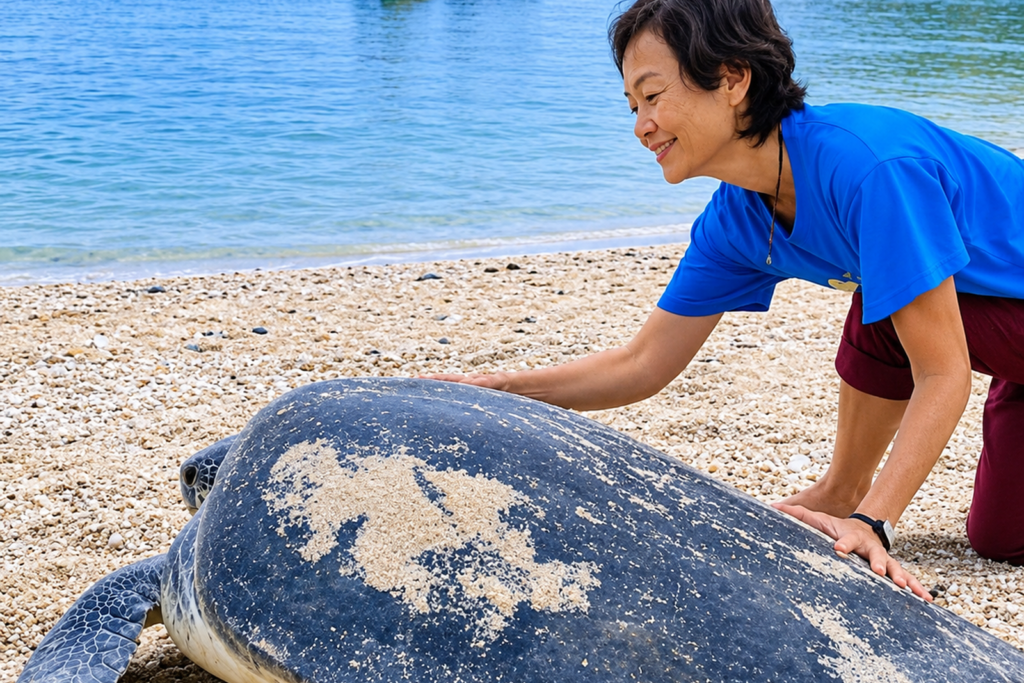
Recognised with the 2026 Merdeka Award, the marine scientist has spent four decades turning research, public participation, and community action into a lasting conservation legacy.
It began with a university assignment in the early 1980s. When Professor Dr Chan Eng Heng was transferred to Universiti Pertanian Malaysia (UPM) in Terengganu, the Fisheries Department approached the university for help investigating the low hatch rates of leatherback turtle eggs at the Rantau Abang Leatherback Hatchery.
Her immediate superior assigned her the task. Although she knew little about turtles at the time, she accepted the challenge. What began as an academic responsibility soon became a lifelong commitment to marine conservation.
In 1984, she made turtles the focus of her research, a decision strengthened by a research grant from ESSO Malaysia Bhd.
More than four decades later, her dedication has earned her the 2026 Merdeka Award for Outstanding Contribution to Environment and Planetary Health. Her work has extended far beyond scientific research, bringing together local communities, volunteers, businesses and fellow researchers in the fight to protect Malaysia’s natural environment.

From an academic assignment to a conservation movement
When Chan began her research, marine conservation was far from mainstream. Sea turtles, particularly those nesting along Terengganu’s coastline, faced intense pressure from commercial egg collection.
Nesting beaches were leased to local egg collectors, leaving conservationists with little direct access to the eggs. To protect them, researchers had to buy the eggs back for incubation and hatchling production.
With corporate funding, Chan and her team purchased eggs and engaged villagers from Redang Island to monitor nesting activities and mark nests for protection.
Convincing egg collectors was not easy. Some initially refused to sell their eggs and continued digging them up, making it difficult to persuade them that the turtles needed protection.
After several years of persistent engagement, Chan succeeded in getting all the egg collectors involved in selling their eggs for conservation. However, she recognised that buying eggs was not a sustainable long-term solution.
She spent more than a decade lobbying for sanctuaries at major nesting beaches on Redang Island. When those efforts stalled, she initiated a public signature campaign to discourage the consumption of turtle eggs.
A breakthrough eventually came when she persuaded then Terengganu Menteri Besar Dato’ Seri Idris Jusoh to grant sanctuary status to important nesting beaches on the island. His visit to her project site at Chagar Hutang allowed him to witness the conservation work firsthand.
The decision marked a significant step towards ending decades of commercial egg collection and protecting important nesting grounds.
Taking conservation beyond hatcheries
A defining part of Chan’s contribution was the establishment of the Sea Turtle Research Unit (SEATRU) in 1984.
Under her leadership, turtle conservation moved beyond conventional practices of collecting eggs, operating hatcheries and releasing hatchlings. Instead, SEATRU adopted a systematic, research-based approach focused on long-term population monitoring.
In 1993, she initiated a turtle-tagging programme at Chagar Hutang. Small, numbered tags attached to individual turtles enabled researchers to identify them when they returned to nesting beaches over subsequent years.
Her team also adopted tracking technologies, including radio and ultrasonic telemetry and satellite tracking, to understand turtle movements, migration routes and inter-nesting habitats.
Another important initiative was in-situ incubation, which protects eggs in their original nests rather than transferring them to artificial hatcheries. This approach allows eggs to develop under natural beach conditions while reducing unnecessary disturbance.
SEATRU also helped transform conservation from what was traditionally viewed as a government responsibility into a collaborative effort involving universities, businesses, volunteers and the wider public.
Mobilising the public to save turtles
One of Chan’s most innovative initiatives emerged during the Asian financial crisis in 1998.
When SEATRU lost its corporate sponsor, securing another source of funding appeared unlikely. Rather than allowing the programme to falter, she turned to ordinary members of the public.
Through the Save Our Turtles Outreach Programme (STOP), people could visit nesting grounds, learn about turtle conservation and experience the work of researchers and conservationists.
The programme also introduced nest and turtle adoption schemes. Members of the public could sponsor individual nests or turtles and receive detailed end-of-season reports covering egg counts, nesting activities and hatchling production.
Media coverage helped amplify the campaign, with journalists publishing extensive reports on the plight of sea turtles, including a front-page feature in The Star.
The initiative demonstrated that conservation did not have to depend entirely on government agencies or corporate sponsorship. Ordinary citizens could also contribute meaningfully to protecting endangered wildlife.
From turtle conservation to community greening
Even after retiring from university life, Chan continued finding ways to turn environmental ideas into practical community initiatives.
In 2011, she was approached to suggest ways of improving a neglected side alley in Kampung Cina, Kuala Terengganu. Her solution was Turtle Alley, a public space decorated with turtle mosaics and educational displays.
The project took about a year to complete. Chan transformed her apartment into a workshop, producing mosaics that eventually covered the alley’s walls and walkways. The project also featured her children’s book, Little Turtle Messenger, reproduced on metallic plates in three languages.
Around the same period, she co-founded the Turtle Conservation Society of Malaysia with former students, including Dr Chen Pelf Nyok. The organisation focuses on river terrapins and freshwater turtles in the Setiu and Kemaman river systems. After moving to Kuala Lumpur in 2016, Chan found another outlet for her environmental passion: urban gardening.
When space in her terrace house became insufficient for growing plants and food, she teamed up with a neighbour to cultivate a long, neglected strip of land beside a monsoon drain. They transformed it into Kebun Longkang, combining urban gardening with efforts to beautify an otherwise overlooked space.
She also established the Klang Valley Plant Acquisition (KVPA) Facebook group, encouraging members to exchange and give away plants without spending money.
The group has grown to nearly 9,000 members and organises plant-sharing events at a nearby car park, with another event scheduled for December 12.
At the Edible Plant Sanctuary in Bukit Damansara, Chan has taken the idea of sustainable urban living further by integrating food production with waste recycling.
She collects dry leaves and grass from roadsides for composting and gathers banana peels from local stalls to make liquid fertiliser. These initiatives demonstrate how discarded organic materials can be turned into useful resources for urban food production.
A legacy that must outlive its founder
For Chan, conservation is never the work of one individual or one generation. Mentorship has therefore been central to ensuring that the work continues beyond her direct involvement.
Following her retirement, Dr. Juanita Joseph took over as SEATRU project leader and now focuses on turtle genetics in Sabah. Dr. Juanita’s former student, Dr. Uzair Rusli, now leads SEATRU.
Meanwhile, Dr Chen Pelf Nyok serves as executive director of the Turtle Conservation Society of Malaysia, continuing the work of protecting freshwater turtles and river terrapins.
Looking ahead, Chan believes building climate resilience is among Malaysia’s most urgent environmental priorities.
She points to increasingly severe floods, heatwaves, droughts, haze and biodiversity loss, stressing the need to halt deforestation and protect water catchment areas.
Her advice to young Malaysians interested in environmental advocacy is straightforward: acquire a sound education, understand the science, identify an area of genuine interest and pursue it with passion, dedication and purpose.
Scientific knowledge, she believes, must underpin meaningful environmental action.
From the nesting beaches of Terengganu to the urban gardens of Kuala Lumpur, Chan’s journey demonstrates that conservation is not confined to laboratories, universities or protected forests. It can begin with a research assignment, grow through community participation and continue through simple everyday actions.
The 2026 Merdeka Award recognises more than four decades of scientific and environmental contributions. It honours a scientist who has shown that protecting the natural world requires not only knowledge and perseverance, but also the ability to bring people together around a shared responsibility.
Author: Ashmita Sivakumar recently completed her A-Levels at Charterhouse Malaysia and is participating in the Petri Dish Fellowship Writing Lab.