
How biotechnology and artificial intelligence are transforming agricultural waste into valuable resources, opening new opportunities for Malaysian Industries.
French chemist Antoine Lavoisier famously said: “Nothing is lost, nothing is created, everything is transformed.”
Imagine walking past a bin filled with discarded banana peels, pineapple leaves or agricultural waste from palm oil production. Most people would regard these materials as rubbish, something to be thrown away, burned or left to decompose.
But what if these unwanted materials could become valuable resources?
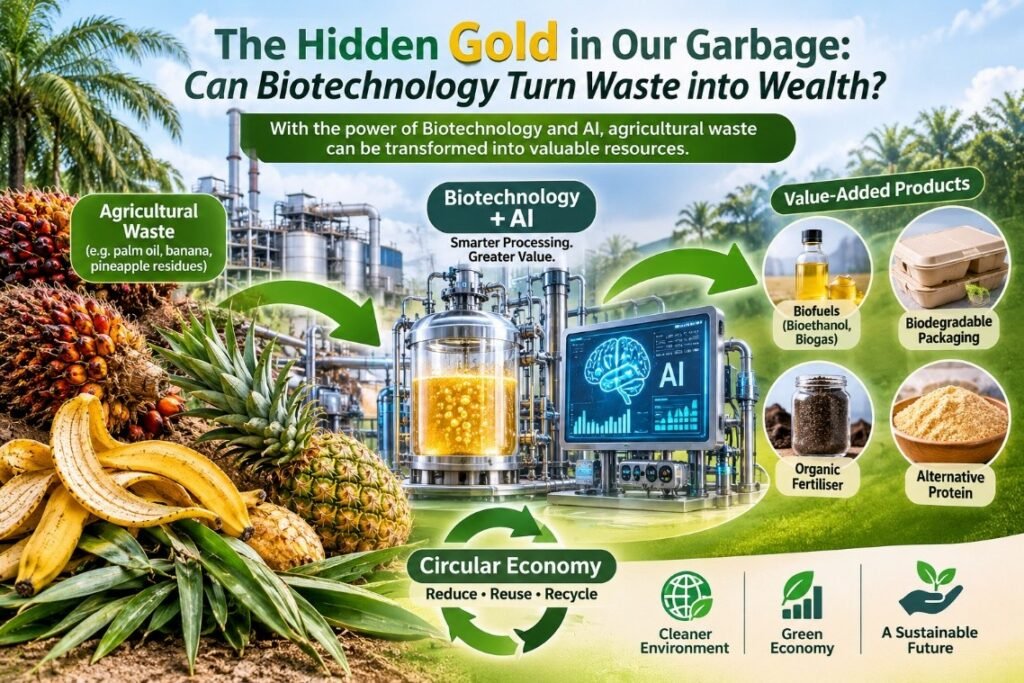
Every year, enormous quantities of agricultural waste are generated worldwide. Banana peels, pineapple leaves, rice husks, sugarcane bagasse and oil palm residues are among the by-products commonly discarded or underutilised. Yet these materials contain substances that could be converted into useful products, including biodegradable packaging, renewable energy, animal feed and food ingredients.

As concerns about climate change, environmental pollution and the depletion of natural resources grow, scientists and industries are rethinking the meaning of waste.
One promising approach is biotechnology, which uses biological systems, microorganisms and enzymes to transform organic materials into valuable products. When combined with artificial intelligence (AI), these processes could become more efficient, precise and economically viable.
This approach supports the development of a circular economy, in which resources are recovered, reused and recycled rather than discarded after a single use.
Malaysia’s agricultural waste: A hidden treasure
Malaysia has a substantial agricultural sector, particularly in oil palm, rice, pineapple and banana production. However, these industries also generate considerable quantities of agricultural residues that require proper management.
The palm oil industry, for instance, produces empty fruit bunches, palm kernel shells, mesocarp fibres and palm oil mill effluent (POME), a wastewater generated during palm oil processing.
Similarly, pineapple processing generates peels, cores and leaves, while banana processing produces large quantities of discarded peels.
Although these materials are often treated as waste, they contain valuable components such as cellulose, hemicellulose, lignin, dietary fibre and bioactive compounds. Depending on their composition and treatment, these substances can serve as raw materials for bioenergy, food processing, biodegradable materials and other industrial applications.
This presents an opportunity for Malaysia to strengthen its bio-based economy.
Instead of simply disposing of agricultural residues, industries could recover their useful components, develop new products, generate additional income and reduce dependence on non-renewable resources.
For farmers and agricultural businesses, waste could become an additional source of revenue rather than another disposal problem.
Giving waste processing a smarter brain
Biotechnology provides the means to convert agricultural waste into useful products. But how can industries make these processes more efficient?
This is where artificial intelligence comes in.
Imagine a palm oil processing facility equipped with sensors that continuously monitor temperature, pH, moisture levels, gas production and other operating conditions.
Traditionally, workers would monitor these conditions and make adjustments based on measurements and experience. An AI-based system, however, can analyse large amounts of collected data, identify patterns and help predict how changes in operating conditions may affect production.
The combination of AI and biotechnology is already being explored in Malaysia’s palm oil industry.
In 2023, researchers from the University of Nottingham Malaysia investigated the use of an integrated artificial neural network and response surface methodology framework to optimise biogas production from palm oil mill effluent.
Their study reported improvements in predicted biogas production of approximately 14.95 per cent and 16.18 per cent respectively, compared with the baseline process used in the research.
These findings demonstrate how data-driven approaches can help researchers identify more suitable operating conditions for biological waste-treatment processes.
For example, an intelligent monitoring system at a palm oil mill could analyse the characteristics of incoming POME and help operators determine the conditions needed to support effective biogas production.
Rather than relying entirely on trial and error, operators could use AI-generated predictions to make better-informed decisions, improve process control and reduce operational uncertainty.
However, AI does not replace biotechnology or human expertise. It provides an additional tool to help researchers and industries manage complex biological processes.
Building a circular economy
The benefits of combining biotechnology and AI extend beyond producing biogas or a single valuable product. They could contribute to a more sustainable economic system known as the circular economy.
In a conventional linear economy, resources are extracted, manufactured into products, consumed and eventually discarded. This take-make-dispose model generates waste and places increasing pressure on natural resources.
A circular economy follows a different approach. It seeks to keep materials and resources in circulation for as long as possible by recovering, reusing and recycling them.
Agricultural waste can play an important role in this transition.
For example, oil palm residues can be converted into bioenergy, while pineapple leaves and fruit-processing residues can be explored as raw materials for fibres, biodegradable materials and other bio-based products.
AI could further support these processes by predicting the availability and composition of agricultural waste, monitoring production efficiency and identifying suitable conditions for different conversion methods.
In the future, integrated biorefineries could use sensors, machine learning and automated monitoring to manage several waste-conversion processes within one facility.
Rather than producing only one product from agricultural residues, such facilities could potentially recover different components and convert them into multiple products, improving the overall value obtained from each tonne of waste.
The challenges behind the technology
Turning agricultural waste into wealth is promising, but it is not without challenges.
One major difficulty is the inconsistent composition of agricultural residues. Their properties can vary according to crop variety, harvesting conditions, seasons and processing methods. These variations can affect microbial activity, conversion efficiency and the quality of the final product.
AI systems also require reliable datasets, appropriate sensors, technical expertise and investment in digital infrastructure. Smaller agricultural businesses may struggle to afford these technologies or maintain the equipment needed to operate them.
Another challenge is translating laboratory research into large-scale industrial applications. A process that performs well under controlled laboratory conditions may produce different results when exposed to the changing conditions of an industrial facility.
AI-generated predictions must therefore be tested and validated through actual experiments and industrial performance data. Human supervision remains essential, particularly when decisions involve product safety, environmental compliance and factory operations.
Successful waste valorisation requires more than sophisticated algorithms. It depends on collaboration between biotechnology researchers, engineers, data scientists, industrial operators, farmers and policymakers.
Government support, research funding and partnerships between universities and industries will also be important in making these technologies commercially viable.
Biotechnology for a zero-waste future
Perhaps the greatest challenge is not a shortage of resources, but the way society perceives them.
A discarded banana peel, a pile of pineapple leaves or wastewater from a palm oil mill may appear worthless. Yet scientific research is showing that these materials contain opportunities for renewable energy, sustainable materials and industrial development.
Biotechnology provides the tools to transform biological waste, while artificial intelligence offers ways to monitor, predict and improve the processes involved.
Together, they could help industries reduce waste, recover valuable resources and move towards more sustainable production systems.
For Malaysia, where agriculture and food processing remain important economic activities, investing in AI-assisted biotechnology could create new opportunities for research, entrepreneurship, rural income generation and green industrial growth.
The next major industrial breakthrough may not necessarily come from discovering another natural resource. It could come from learning how to make better use of the resources already available.
The greatest treasure may not be buried beneath the ground. It may be hiding in the waste we throw away.
Author: Kuberan Ravichandran has recently completed his studies in Food Security at UniversitiMalaysia Kelantan. He is participating in The Petri Dish Fellowship Writing Lab.