
What can a handful of dust tell us about a planet’s history? Quite possibly, more than we think.
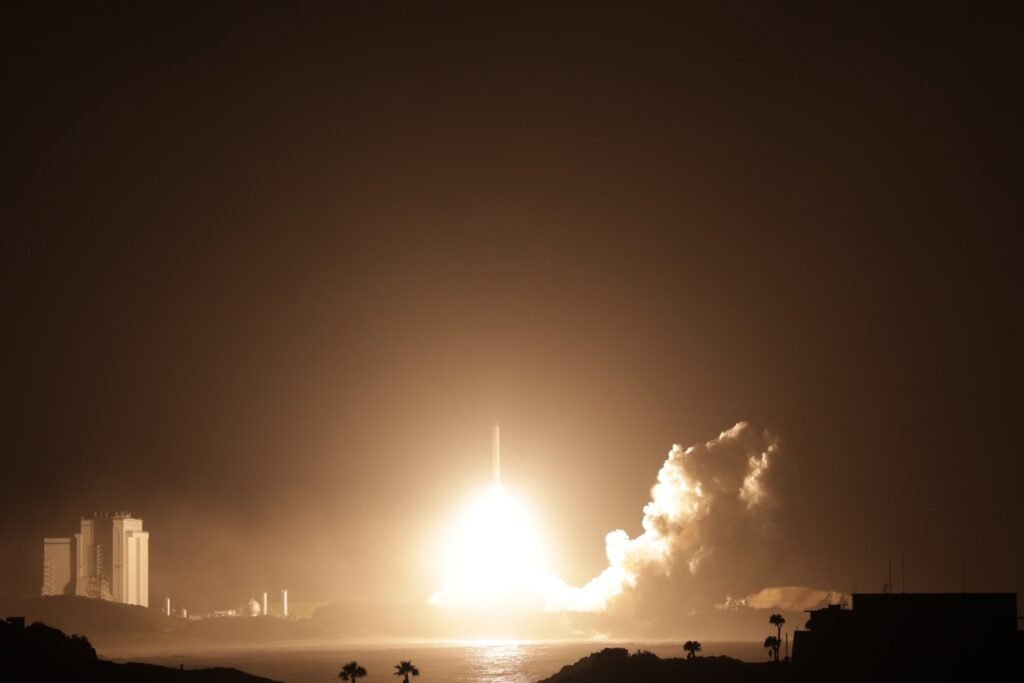
On October 20, 2026, JAXA’s flagship MMX (Martian Moons eXploration) mission roared into a pre-dawn sky aboard an H3 rocket from the Tanegashima Space Centre, aiming to accomplish a feat never before achieved in space exploration.
Many spacecraft have successfully landed on Mars’ dusty red surface over the last half-century, yet none have ever touched down on either of its two mysterious satellites: Phobos and Deimos. MMX is on a multi-year journey to change that history, heading to explore the moons up close and bring a piece of them back to Earth.
Uncovering How Phobos and Deimos Formed
Scientists have fiercely debated where Phobos and Deimos actually came from for decades. Currently, there are two leading theories. First, people have theorised that they could be captured asteroids; they drifted too close and were permanently trapped by Mars’ gravitational field. Second, they could be giant impact remnants – massive clumps of debris blown into space after a collision involving Mars billions of years ago.

Moreover, Phobos orbits very close to Mars, at about 7,000km away. Over the years, intense meteor impacts on the Red Planet have blasted surface dust and rocks across space, naturally coating Phobos in layers upon layers of Martian soil. In that sense, Phobos inevitably acts like a catcher’s mitt. By analysing samples from Phobos, researchers hope to gain an unprecedented window into Mars’ history.
A Multi-Act Space Exhibition
The mission concept officially took shape in 2015, relying heavily on small-body sample collection techniques JAXA pioneered during its historic Hayabusa asteroid mission; in 2003, the Hayabusa spacecraft became the first to ever land on an asteroid and successfully return a sample of its material back to Earth.
The voyage itself is structured across a precise timeline. Next August, MMX is scheduled to reach the Martian system and settle into orbit. In 2029, the spacecraft will deploy Idefix – a small space rover manufactured by French (CNES) and German (DLR) agencies, which will be used to seek out potential landing sites directly on Phobos’ surface. In 2030, MMX plans to execute two soft landings on Phobos. Using a pneumatic sampling system – a mechanism that uses a burst of pressurised gas to kick up loose soil – the spacecraft will collect at least 10 grams of surface material. This loose soil and dust over solid bedrock is known as regolith, which is what the surface material will consist of. Finally, in 2031, a return capsule will head back towards Earth after completing close flybys of Deimos, parachuting down into the Australian desert with the samples in cargo.
Navigating Extreme Engineering Challenges
Reaching the two moons and returning requires jumping over major hurdles. Firstly, Phobos and Deimos are tiny and lumpy, causing their gravity to be extraordinarily weak. They are considered microbodies, which traditional satellites orbits can’t wrap around. To overcome this, MMX must navigate using quasi-satellite orbits, circling Mars alongside the moons in almost perfect sync.
This project marks a crowning milestone for aerospace engineering. It required engineers to design a spacecraft capable of traveling to Mars, executing a micro-body landing, breaking free from Mars’s gravity well, and executing a precision capsule drop back to Earth.
Why It Matters
Bringing physical pieces of the Martian system back to Earth enables scientists to run tests with heavy, advanced lab equipment that would never feasibly fit on a spacecraft. This mission thus allows scientists to learn as much as they possibly can from the samples collected through a variety of procedures to meaningfully advance planetary science.
Beyond that, if the moon turns out to be captured asteroids, they could carry organic materials and water that shed light on how life-enabling compounds moved through our early Solar System. If they formed from a giant impact, they’d hold a preserved record of Mars during an era where its environment looked remarkably close to ours.
Mars was once a significantly warmer and wetter planet, with geological evidence suggesting that liquid water flowed across its surface billions of years ago. Understanding how it transitioned into the cold, relatively dry world observed today could provide important insights into planetary evolution. The findings could therefore help researchers better understand how potentially habitable environments developed on terrestrial planets, including Earth.
Author: Ashmita Sivakumar has recently completed her A-Levels at Charterhouse Malaysia and is currently participating in the Petri Dish Fellowship Writing Lab.