
Image credits: Photo: Royal Swedish Academy
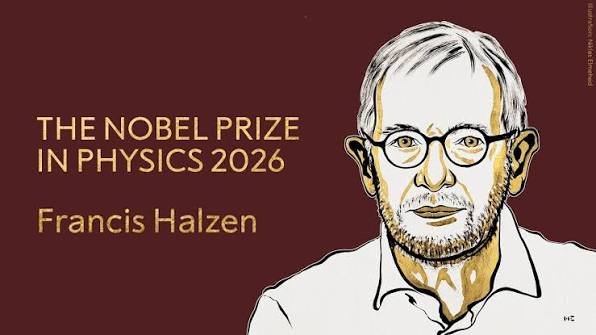
On the 6th of October 2026, the Belgian-American physicist Francis Halzen received the 2026 Nobel Prize in Physics.
The principal investigator at the University of Wisconsin-Madison was awarded by the Royal Swedish Academy of Sciences.
The award was given in recognition of his contributions to the conceptualisation and construction of the IceCube Neutrino Observatory, and for the discovery of high-energy neutrinos originating from deep space.
In a rare distinction for modern physics awards, Halzen was awarded the full 12 million Swedish kronor (Around RM5 million) prize solo, highlighting the significance of his novelty.
The Giant Telescope Below the Penguins

Halzen’s decision to build IceCube, a giant telescope located deep inside the ice at the South Pole, opened an entirely new window for astronomy researchers.
Instead of looking at the sky with lenses, it uses one cubic kilometre of clear Antarctic ice as a particle trap.
Such a feat was achieved by drilling deep holes into the ice using melted hot water and dropping down 86 long cables containing more than 5,000 light sensors.
These light sensors sit frozen in total darkness, waiting to catch tiny flashes of light caused by particles interacting with the frozen ground.
The Engineering Gamble
One specific element about Halzen’s creation that made it an outstanding project was having to pull off a giant engineering project in the middle of Antarctica.
The idea behind constructing a scientific lab in freezing, sub-zero conditions at the South Pole was considered crazy by many scientists at first.
Even Halzen himself admitted he felt constantly terrified and insecure that the project would fail. Halzen shared: “The whole story was a story of panic… from the beginning, when people thought that this was a very cute idea, but it wouldn’t work. Well, that’s what we thought too”.
Despite these fears, the team figured out how clear the deep polar ice was and made the detector work successfully.
How IceCube Traces Cosmic Marvels
The main goal of IceCube is to catch the activity of neutrinos coming into earth.
Neutrinos are subatomic particles, they are often called “ghost particles” because of their near massless attribute.
Since they have neutral charges and pass right through normal matter, trillions of them flow through our bodies every second without us noticing.
When a high-energy neutrino collides with a nucleus of an atom in or near the ice, it produces secondary charged particles that emit a faint blue glow known as “Cherenkov radiation”.
The IceCube can trace the path of neutrinos directly back to their original cosmic sources by measuring the faint blue flashes, allowing scientists to identify whether a giant black hole is spitting energy at us, or a supernova is occurring nearby.
South Pole’s Legacy in Astronomy
It is not the first time the icy region was used for outer spafe research projects.
Emphasising the sole importance of polar environments for scientific research, legendary astrophysicist and polar science proponent Dr. Carl Sagan once highlighted why remote polar regions are essential to modern discovery:
“The extreme conditions of the polar regions offer us an irreplaceable natural laboratory unlike anywhere else on Earth. Deep within these vast, undisturbed ice sheets lie environmental records and physical conditions that allow us to ask fundamental questions about our planet and the wider universe. To turn away from polar science is to close our eyes to one of the clearest windows we have into the cosmic past”.
Halzen’s groundbreaking work at IceCube has produced landmark discoveries over the last decade.
This includes the first detection of high-energy cosmic neutrinos from beyond our solar system, and the mapping of high-energy neutrino emissions from our own Milky Way galaxy.
The Nobel prize recognises the birth of a brand-new way of looking at cosmos, demonstrating how the Earth’s most extreme polar environments can serve as our most powerful lenses into the vast unknown.
The Next Steps for Halzen
Winning the Nobel Prize marks a big milestone, but Halzen and his team are still looking ahead to the future of space research.
IceCube recently received new equipment upgrades to lower its detection limits and calibrate the ice better.
On top of that, plans are already underway for IceCube-Gen2, an expanded detector that will be eight times larger than the current facility. As neutrino astronomy continues to grow, Halzen’s South Pole expeditions will keep giving scientists a brand-new way to study the deepest mysteries of our universe.
About the Author: Wong Jia Qi is an incoming freshman at Monash University Malaysia. She is participating in The Petri Dish Fellowship Writing Lab.