
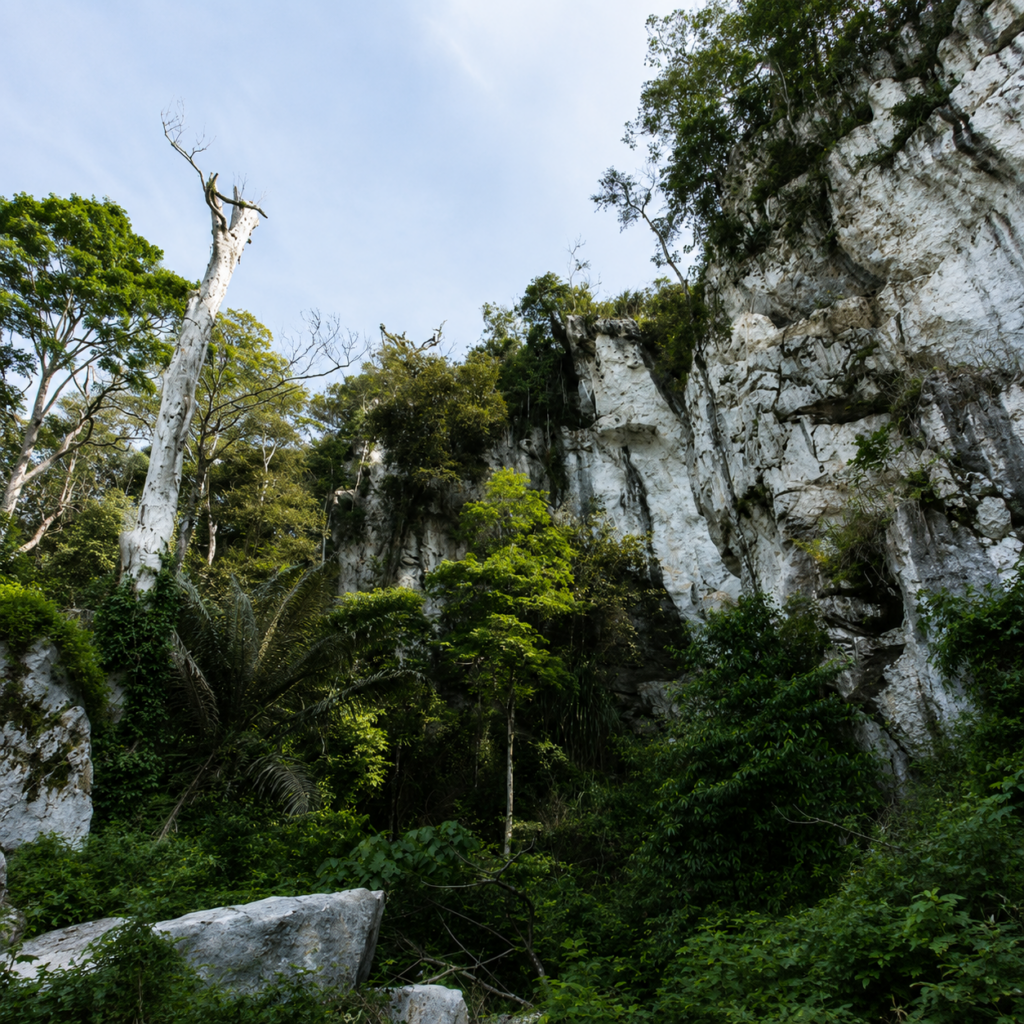
The ancient limestone hill is home to rare biodiversity and the century-old Sakyamuni Caves Monastery, both now facing pressure from quarrying activities.
Environmentalists and civil society groups in Malaysia rarely get a moment to catch their breath. If it is not another dam being built in Borneo, flooding vast tracts of forest and threatening hundreds of plant and animal species, it is the conversion of precious peatlands into plantations for cash crops.
The relentless pressure on the natural landscape does more than destroy forests, wetlands and wildlife. It also disrupts the lives of indigenous and local communities who have depended on these lands for generations — for food, livelihoods, culture and a sense of belonging.
For environmental NGOs, it means being perpetually on the front line — challenging projects, raising alarms, taking governments and developers to task, and trying to defend what cannot speak for itself: the forests, rivers, wildlife and communities whose voices are too often the easiest to ignore.
Now the focus has shifted to Gunung Kanthan in Perak, a limestone landscape recognised internationally for its remarkable plant and animal biodiversity, including species found nowhere else in the world. But this ancient mountain is now under pressure from quarrying.

The threat is not only to rare plants and animals that have evolved here over millions of years, but also to a century-old Buddhist monastery whose spiritual life has long been intertwined with the caves and the mountain.
Gunung Kanthan is estimated to be around half a billion years old and is the most extensive surviving peak of the iconic Kanthan karst complex. For generations, it has stood quietly over the Kinta Valley, its limestone cliffs, caves and forests carrying a remarkable story of evolution.
But the mountain is more than an impressive geological landmark. It is a living ecosystem made up of a mosaic of natural and human-influenced habitats. Its vegetation ranges from the ground beneath our feet and the steep hill slopes to the summit and even aquatic habitats, each creating its own small world.
The thin, alkaline soils and changing conditions across the limestone create a remarkable variety of ecological niches. Life has adapted to these demanding conditions in ways that are often highly specialised.
Among them are limestone-loving plants that may struggle to survive elsewhere — delicate herbs and rock-face species, Pandanus, calcicole cycads, orchids and palms, alongside the trees and shrubs that form the mountain’s wider vegetation.
What may look from a distance like just another limestone hill is, in reality, a complex web of life. Its cracks, cliffs, caves and thin soils have become homes for species that have spent generations learning how to survive in this unusual landscape.
And that is what makes Gunung Kanthan so precious — and so vulnerable.

The endangered Elephant snail (Pollicaria elephas), a rare species found in the Kanthan Hills.
Appeal to Prime Minister
Recently, a group of monks from the caves monastery appealed to Prime Minister Anwar Ibrahim to intervene to save the century-old Buddhist site from eviction and possible demolition.
For years, devotees from the Sakyamuni Caves Monastery, located in Gunung Kanthan, an area that falls within Anwar’s Tambun parliamentary constituency, have been locked in a court battle resisting eviction following a lease granted by the state government to a cement company to carry out quarrying activities.
Speaking at a press conference organised by rights group Lawyers for Liberty, lawyer N Surendran urged Anwar to declare the monastery complex and surrounding hillside a national heritage site, saying such a move would protect both its cultural significance and unique biodiversity.
“We call upon the prime minister to do his duty to his constituents in the Tambun area, and also his duty as the head of the federal government,” Surendran said.
He said Anwar had the authority to help resolve the issue, noting that the Sakyamuni Caves Monastery had stood at the site for more than a century.
Surendran also highlighted the ecological importance of Gunung Kanthan, saying its caves and limestone landscape support plant and animal species that are the result of millions of years of evolution, including rare spiders and snails.
He pointed out that the area’s ecological significance had already been recognised by the authorities, which had included Gunung Kanthan within the Kinta Valley geopark landscape.
Surendran is right. Internationally, Gunung Kanthan is recognised as a haven for extraordinary plant biodiversity — including species found nowhere else on Earth. The lawyers are defending it as more than just a mountain — but as a living library of nature, written over millions of years and capable of being erased in a matter of days.
Special in Many Ways
What makes Gunung Kanthan even more precious is that it is the type of locality for several species discovered nowhere else. Many limestone plants are confined to a particular karst hill or even a tiny microhabitat within it.
That is why such a small area can harbour so many unique species — and why the loss of a single hill can mean the loss of species that have nowhere else to go.
Gunung Kanthan is also believed to contain Perak’s only remaining patch of limestone forest, an increasingly endangered habitat that provides refuge for large trees, birds, reptiles and frogs, as well as the endangered serow, or kambing gurun.
But the mountain holds another kind of memory.
Across Peninsular Malaysia, limestone caves have preserved important archaeological and palaeontological evidence. They have also long been places of spiritual significance. Hindu and Buddhist communities have used caves as sacred spaces, and Gunung Kanthan is home to several religious sites, including the century-old Sakyamuni Caves Monastery.
This is what makes the prospect of quarrying so difficult to comprehend. A limestone landscape may take millions of years to form, yet explosives and heavy machinery can tear it apart in a matter of hours. Once the caves, cliffs and forests are gone, they cannot simply be restored.
If Gunung Kanthan is important enough to be recognised for its geological and ecological value, surely that recognition should also mean protecting it from being destroyed by quarrying.
There is another possibility that deserves consideration. Instead of seeing the mountain only as a source of limestone, Perak could see it as an asset for the future — for sustainable tourism, scientific research, caving, rock climbing and heritage tourism.
With its limestone hills, temple caves, biodiversity and dramatic landscapes, Perak could perhaps develop its own version of Guilin — a place where nature, faith and tourism coexist without destroying the very landscape that draws people there.
The choice, ultimately, is not simply between conservation and development. It is between a mountain that can continue giving for generations, and a resource that can be extracted only once.