
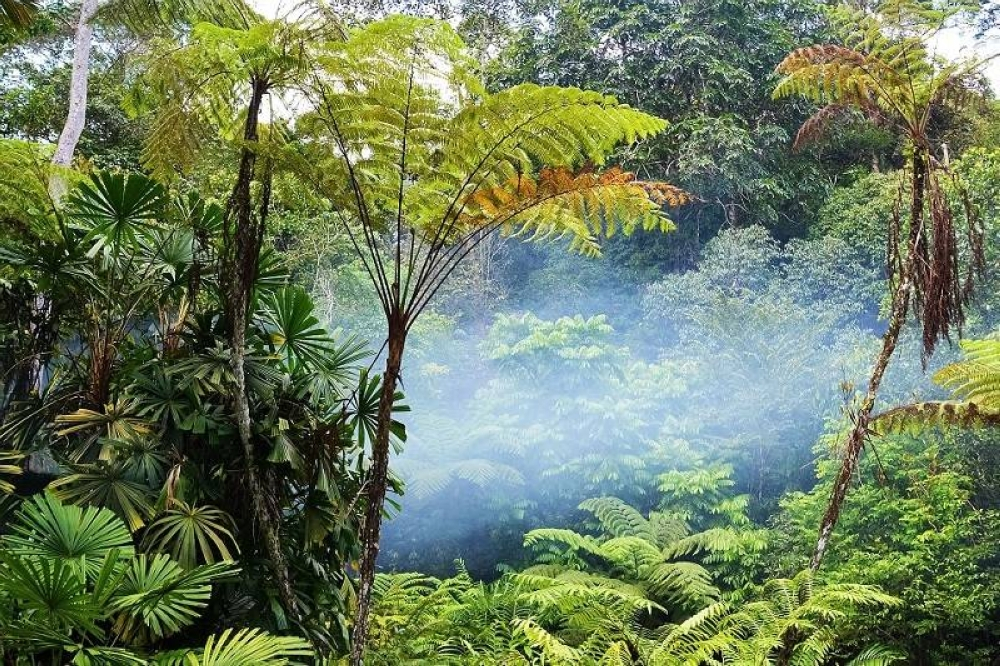
Sarawak’s rich biodiversity — from its rainforests and diverse plant life to its vast genetic resources — is emerging as a strategic asset in the state’s ambition to capture a share of the global biotechnology market.
Sarawak is positioning its vast biodiversity as a foundation for entering the global biotechnology economy, with Premier Datuk Patinggi Tan Sri Abang Johari Tun Openg saying the state needs only a small share of the projected US$4.3 trillion global market to create a significant economic opportunity.
Abang Johari said Sarawak’s strategy was to combine its natural biological resources with scientific research, technology and investment, moving beyond the traditional exploitation of natural resources towards developing high-value products for international markets.
He said Fortune Business Insights projected the global biotechnology market to expand from US$1.5 trillion in 2026 to US$4.3 trillion by 2034.
“In other words, there is ample space for us to contribute to the growth of biotechnology,” he said at the foundation-laying and exchange-of-agreements ceremony for the Sarawak Bioindustrial Park (SBP).

Asked how much of the global market Sarawak could potentially capture, Abang Johari said the eventual figure would depend on the investors and companies attracted to the state.
“I don’t know. It depends on the investors. Once they come in and start investing, then we will know.
“Just a slice of pie pun cukup (is enough). Even a small share would be enough,” he told reporters.
The comment reflects Sarawak’s emerging strategy: it does not need to dominate the global biotechnology industry. Its advantage may lie in developing specialised products from the biological wealth of its forests and ecosystems.
From biodiversity to products
At the centre of this strategy is the Sarawak Bioindustrial Park, designed to extend the work of the Sarawak Biodiversity Centre (SBC) into commercial applications.
Abang Johari said the park would provide a platform for translating scientific discoveries into products for international markets.
“Research can be carried out at the Sarawak Biodiversity Centre, and the outcomes must then be applied to industrial products,” he said.
Sarawak’s forests contain a vast diversity of plants and other biological resources, many of which may contain compounds with applications in healthcare, pharmaceuticals, cosmetics and other industries.
The challenge is to identify those compounds scientifically, understand their properties and develop them into safe and commercially viable products.
“We have a vast reservoir of biodiversity resources. What we can do is contribute some of these resources to the Bioindustrial Park and attract investors,” Abang Johari said.
He said investors would be able to work with the SBC, which has already developed various research-based products with potential for commercialisation.
AI, DNA and the new biotechnology
The Premier also highlighted the potential of artificial intelligence and DNA data to accelerate biotechnology research.
For a biodiversity-rich region such as Sarawak, genomic information combined with AI-assisted analysis could help researchers identify biological resources and compounds with potential applications more rapidly.
This could give Sarawak an advantage in a sector increasingly driven by data as much as by physical resources.
But technology alone will not create a biotechnology industry.
Sarawak will need scientists, laboratories, intellectual property expertise, investors, regulatory systems and companies capable of taking discoveries through the long process from laboratory research to commercialisation.
Abang Johari stressed that the state would continue investing in research and developing its scientific talent.
“The only question is whether we are willing to put in the effort. Sarawak will invest in research.
“I will reinvest our revenue into research so that we can become a player in the new economy,” he said.
Learning from Singapore and Switzerland
Abang Johari said Sarawak could learn from countries such as Singapore and Switzerland, which have developed strong biotechnology and biomedical industries despite having far fewer natural resources.
The comparison underlines the economic shift Sarawak is seeking.
The state has traditionally depended heavily on natural resources such as timber, oil and gas and plantations. Biotechnology offers a different model — generating value from knowledge about biological resources rather than simply extracting and selling the resources themselves.
A biological compound that can be developed into a pharmaceutical, healthcare or cosmetic product may generate vastly greater value than the raw material from which it originated.
But commercialisation also brings a responsibility to protect the biodiversity on which the industry depends.
Sarawak’s biotechnology ambitions will therefore require a careful balance between scientific discovery, commercial development and conservation.
Its forests cannot be treated merely as warehouses of potentially valuable compounds. They are complex ecosystems whose long-term protection is essential to the very industry Sarawak hopes to build.
A sustainable biotechnology ecosystem could eventually connect the SBC, universities, research institutions, biotechnology companies, investors and local communities.
From natural wealth to knowledge wealth
The biggest challenge may not be discovering biological resources. It will be developing the scientific and commercial ecosystem capable of turning discoveries into globally competitive products.
That requires sustained investment, skilled researchers, strong intellectual property protection and a pathway for promising discoveries to move from laboratories into industry.
It also requires patience. Biotechnology development can take years and substantial capital before a discovery becomes a commercially successful product.
Sarawak’s willingness to reinvest its revenue into research could therefore be crucial.
The objective is not simply to own biodiversity, but to understand it, protect it and create value from it responsibly.
The global biotechnology market may be projected to reach US$4.3 trillion by 2034.
Sarawak does not need to capture much of it.
As Abang Johari put it, “even a small share would be enough.”
The real test is whether that small slice can be built on something much larger: Sarawak’s ability to transform its biodiversity into scientific knowledge, and that knowledge into products the world is willing to buy.