
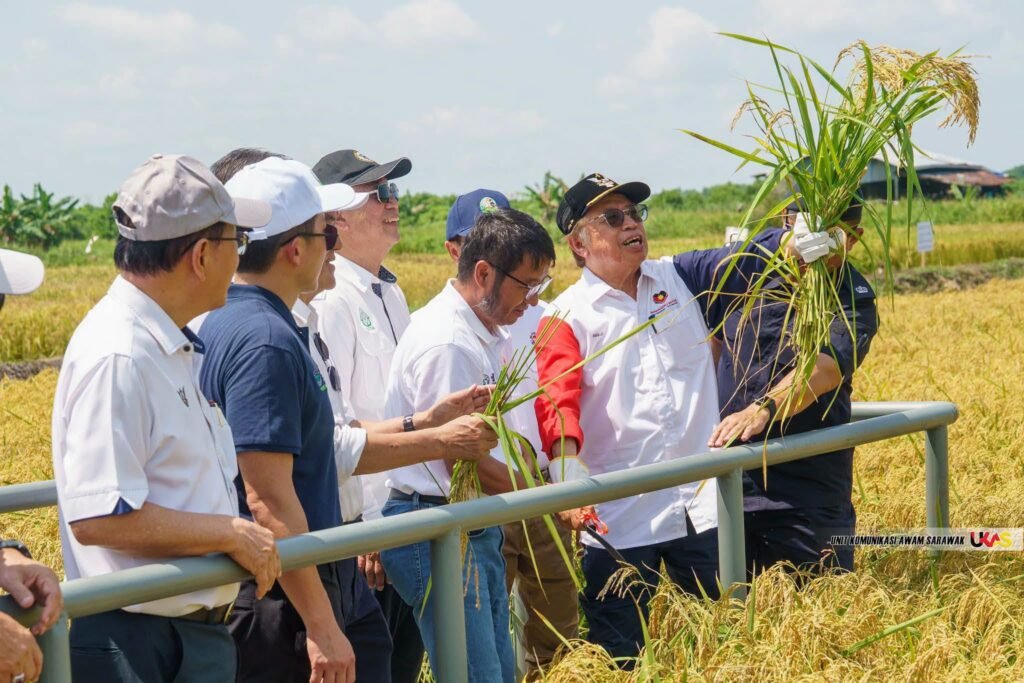
MIRI — Sarawak is looking to a new perennial rice variety to strengthen food security and reduce its heavy dependence on imported rice after a pilot project in Kuala Baram showed promising results.
Premier Datuk Patinggi Tan Sri Abang Johari Tun Openg said the perennial rice technology could mark a significant breakthrough for Sarawak’s agrofood sector because the crop can regrow after harvest without replanting.
“This is a very important achievement because this rice variety does not need to be replanted after harvesting. It regrows once the rice has been harvested,” he said after launching the Harvesting of Perennial Rice Pilot Project.
Developed through a research collaboration between Yunnan University and local researchers, the perennial rice has recorded an estimated annual yield of about 14.5 metric tonnes per hectare from two harvests.
Abang Johari said additional harvest cycles could be possible depending on soil conditions and nutrient management.

The technology could also open up new possibilities for using Sarawak’s extensive peatlands for food production, he said.
“We have extensive peatlands, and now with this new technology, we can use it for rice production. Land that was previously underutilised can now become a source of food production,” he said.
Sarawak currently produces only about 21 per cent of its rice requirements, leaving the state reliant on imports for the balance.
The state government aims to increase local production to at least 60 per cent as an initial step towards achieving greater rice self-sufficiency.
Sarawak consumes about 240,000 tonnes of rice annually. Increasing local production, Abang Johari said, would strengthen the state’s food security while reducing its exposure to fluctuations in global supply and prices.
“If our production reaches a higher level, we will not only be able to meet our own needs, but if there is a surplus, we can also explore export opportunities,” he said.
The perennial rice project also reflects a broader effort to make agricultural land more productive while reducing the costs and labour associated with repeated planting.
Abang Johari said the state government planned to establish an anchor company model to support smallholders, particularly by helping farmers market their produce and providing a stable market.
Such a model, he said, would ensure that farmers could participate sustainably in the rice industry as production expands.
For Sarawak, the significance of the perennial rice project extends beyond a new farming technology. With much of its rice supply still dependent on imports, increasing domestic production could become an important component of the state’s long-term food security strategy.