What looked like nature’s sudden fury was in fact a complex chain reaction of rock, ice, water and gravity — with a warming Himalaya adding a troubling new dimension.
For pilgrims travelling towards Mount Kailash, the Himalayas are a landscape of faith — immense, silent and seemingly immovable. But mountains move.
The deadly flash flood that tore through Nepal’s Rasuwa district along the Tibet border was not simply a case of a river overflowing after heavy rain. Scientists are piecing together a far more dramatic sequence: a massive failure of bedrock, the collapse of a glacier sitting above it, an avalanche of ice and rock that blocked a river, and the sudden release of water that had accumulated behind the temporary natural dam.
In other words, the flood was not one event. It was a chain reaction. And that chain helps explain the extraordinary force of the water surge.
It began with a mountain giving way
Initial reports suggested that an earthquake had triggered an avalanche. But subsequent satellite imagery and analysis by the US Geological Survey pointed to something different.

A huge section of glacier and rock, estimated at 600 metres wide, collapsed from an altitude of roughly 5,200 metres, falling about 1,200 metres into the valley. The USGS later concluded that the collapse itself generated a seismic signal equivalent to a magnitude 5.2 event.
That distinction matters.
The earth shaking did not necessarily cause the glacier to fall. The glacier and rock collapse was so enormous that its movement caused the ground to shake.
Dr Mohd Farooq Azam, a cryosphere specialist at the International Centre for Integrated Mountain Development, described the immediate trigger as a bedrock failure. When the bedrock gave way, the glacier above it was swept along.
The estimated volume was staggering: between 100 million and 200 million cubic metres — roughly equivalent to 40,000 to 80,000 Olympic-sized swimming pools.
That is an extraordinary amount of frozen water and mountain material suddenly in motion.
When ice becomes water — and carries a mountain with it
An ice avalanche does not behave like a simple block of ice sliding down a slope.
As it plunges downhill, friction generates heat and can melt some of the ice. At the same time, the moving mass can sweep up soil, rocks and sediment.
What begins as ice therefore becomes a rapidly moving mixture of water, ice, rock and debris.
That appears to have been crucial in Rasuwa.
Cryosphere researcher Sunwi Maskey explained that the friction generated during the descent could have melted glacier ice into water, while the avalanche swept soil, rocks and sediment into the flow.
The mountain was effectively feeding its own disaster.
The moving mass gained water and sediment as it travelled downhill. Then it encountered something that transformed the event from a massive avalanche into a devastating flood – a river.
The natural dam
The avalanche blocked the Lhende Khola, a high-altitude river that flows from Tibet into Nepal and eventually feeds into the Bhotekoshi and Trishuli river systems.
For a moment, the debris became a natural dam.
But rivers do not stop simply because a mountain has fallen into their path.
Water continued to flow towards the blockage. Behind the temporary dam, water accumulated. Pressure increased. And eventually the barrier failed. This is the point at which the disaster became a flood.
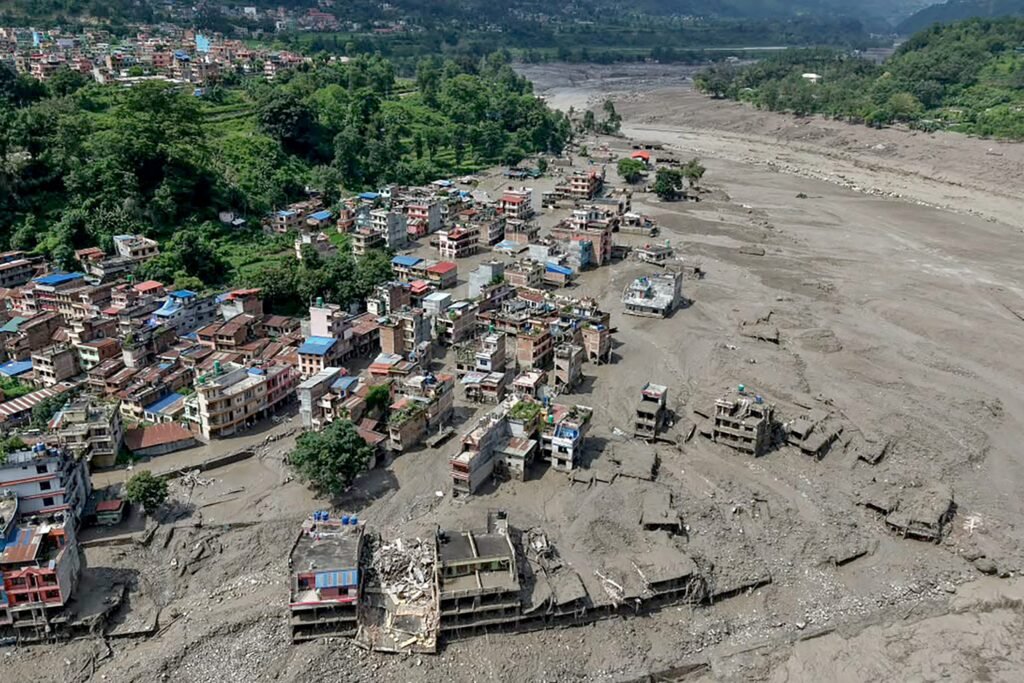
The accumulated water was suddenly released downstream, carrying with it the debris that had formed the temporary dam. Instead of an ordinary river current, communities downstream faced a rapidly moving wall of water laden with mud, rocks and other material.
Dr Upmanu Lall of Columbia University explained that this kind of blockage can transform normal river flow into a catastrophic flash flood when the stored water is released almost instantaneously.
The result was a form of natural dam-break flood — amplified by the enormous amount of material already mobilised on the mountain.
Why the water became so destructive
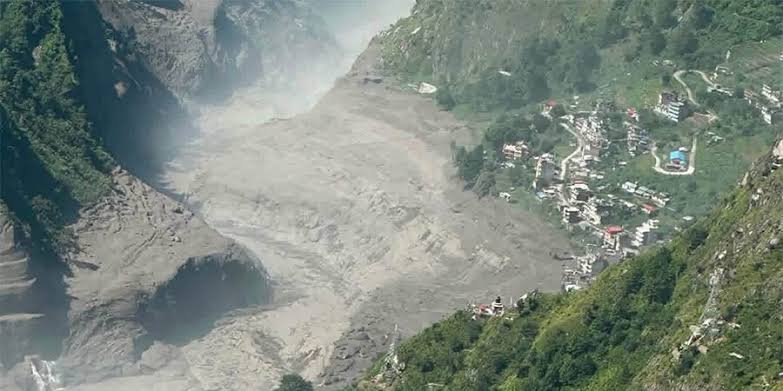
Water alone is dangerous. Water carrying boulders is something else. A debris-laden flood has enormous destructive power because it combines the mobility of water with the weight and momentum of solid material.
Rocks become battering rams. Mud fills channels and buildings. Trees, vehicles and infrastructure can be swept into the flow, adding still more material.
And Himalayan valleys intensify the danger. Steep slopes accelerate the movement downhill while roads, settlements and pilgrimage routes are often concentrated along the same river corridors that provide the easiest passage through the mountains.
The geography that makes these valleys accessible also makes them vulnerable.
That helps explain why the flood travelled so far downstream, with bodies later recovered hundreds of kilometres away through the Trishuli and Narayani river systems.
And then there is climate change
This is where the science becomes more complicated.
It is tempting to describe the disaster simply as a consequence of global warming.
Scientists caution against that.
There is not yet enough evidence to say that climate change directly caused this particular glacier collapse. Disaster risk expert Jeff Da Costa of the University of Reading said warming is changing glaciers, permafrost and slope stability across the Himalayas, but that the individual collapse requires further analysis before it can be attributed to climate change.
That scientific caution is important. But it does not mean climate change is irrelevant.
A warmer atmosphere can increase glacier melt. Rain that might historically have fallen as snow can instead fall as rain, adding water to the mountain system. Water can seep into slopes and between rock and soil, potentially contributing to instability.
Dr Lall suggested that conditions leading to the Rasuwa collapse may have been developing for weeks or even months.
The broader trend is unmistakable.
According to ICIMOD, glaciers across the Hindu Kush Himalaya lost about 12% of their total area and 9% of their ice reserves between 1990 and 2020.
The concern, therefore, is not that climate change makes every glacier fall.
It is that warming is changing the physical conditions in which these mountains operate.
Glaciers retreat. Frozen ground changes. Slopes become exposed. Water moves differently through ice and rock. Rainfall patterns shift.
The mountain system itself is changing.
Could this happen elsewhere?
The answer is yes.
Similar hazards can occur anywhere glaciers, unstable slopes, heavy rainfall and river valleys come together — from the Himalayas and Andes to the Alps, Alaska and other high mountain regions.
The mechanism may differ. A glacier may collapse. A landslide may block a river. A glacial lake may burst.
But the underlying principle is the same: Ice, rock and water can suddenly turn one another into amplifiers of destruction.
The 2021 Chamoli disaster in India’s Uttarakhand, for example, was also associated with a bedrock failure that triggered a massive flow of ice, rock and debris downstream.
When minutes matter

Perhaps the most important lesson from Rasuwa is not simply what caused the flood.
It is how little time people may have had to escape.
One local official described feeling the ground shake and then seeing what appeared to be a roughly 100-metre-high wall of water coming downstream. The Timure bazaar was wiped out almost immediately.
Experts say that for an event of this magnitude, the warning window may be measured in minutes, not hours.
That changes what disaster preparedness means.
Satellite imagery, soil-moisture sensors, drones and other technologies can help identify unstable slopes. But detecting a hazard is not enough. Communities need evacuation routes, drills and systems that can communicate danger immediately.
And perhaps there is one final lesson. We often speak of floods as though water itself is the enemy. In the high mountains, it is rarely that simple. The water may begin as ice. The ice may carry rock. The rock may dam a river. The river may become a reservoir.
And when the dam breaks, the reservoir becomes a weapon of gravity. That is the science behind nature’s fury. The Himalayas may look eternal.
Their physics are not.