
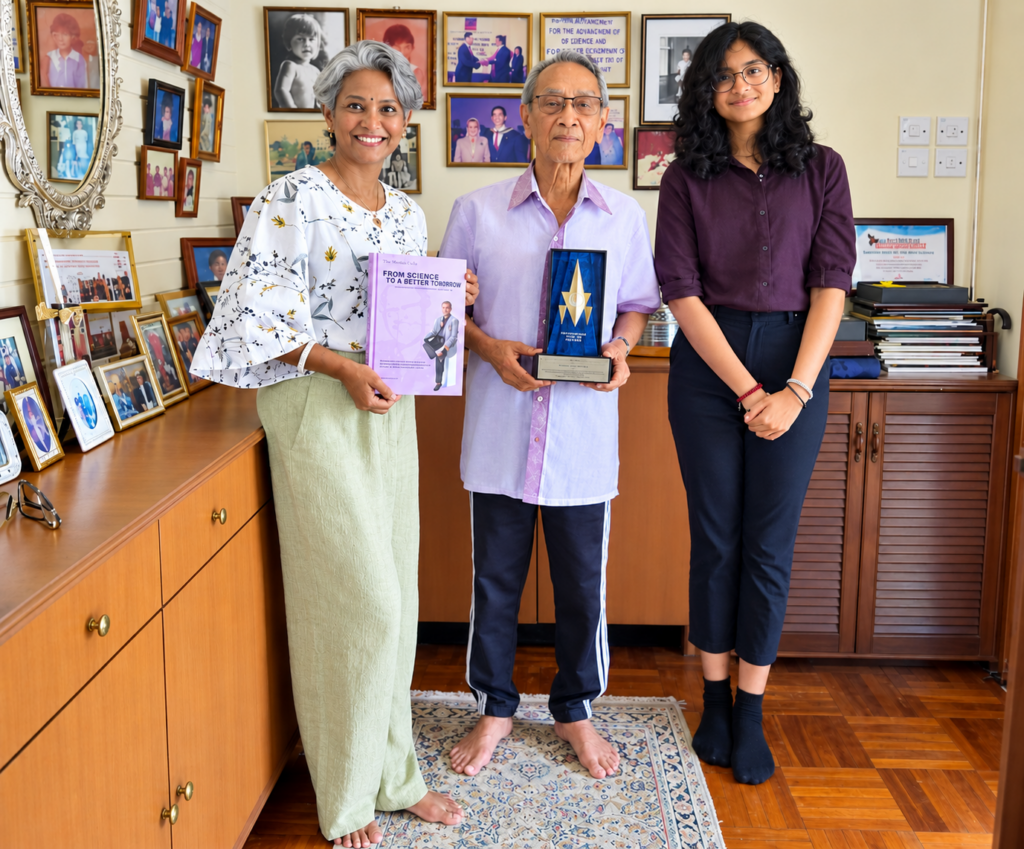
At 94, Professor Emeritus Tan Sri Omar Abdul Rahman still has something he wants to fix. After a career spanning veterinary science, university leadership and national science policy, his attention has turned to a challenge he considers fundamental to Malaysia’s future: how its people live together.
His current passion is Rukun Negara and Harmoni-Mesra, an effort to turn national unity from an aspiration into a lived experience.
It is an unexpected destination for a man whose career began with diseased animal tissues and laboratory research. Yet Omar’s life has followed a consistent pattern: understanding problems, identifying what is missing and building what is needed.
From Kota Bharu to Cambridge
Born in Kota Baru, Kelantan, in 1932, Omar grew up in modest circumstances. His father worked at a printing press, while his mother, a housewife, died of cholera when he was a teenager. He and his two sisters looked after one another until their father remarried after the Second World War.

His interest in science was encouraged by a cousin who studied science at Penang Free School before becoming a science teacher in Australia. At Ismail English School, his science teacher, Kam Tek Soon, further nurtured that interest.
English opened another door. Asked how a boy from Kelantan acquired the language skills needed to study at Cambridge, Omar gave a simple answer: “Enid Blyton books.”
He excelled academically, becoming one of only three students in Kelantan to obtain First Grade in the Cambridge School Certificate examination.
His father initially wanted him to study medicine. However, a talk by a veterinary officer from the State Veterinary Department changed his mind. Veterinary medicine appealed to him, although there was nowhere nearby to study it.
With his headmaster’s help, he applied for a scholarship to study at the University of Sydney and was accepted.
His journey was an adventure in itself. He flew from Kota Bharu to Singapore before travelling by ship to Fremantle, Western Australia. Three days into the voyage, the ship developed engine trouble near Bali. After the vessel resumed its journey, government officials met him in Fremantle and arranged his train journey to Sydney.
Omar graduated in veterinary science in 1958 and joined the Veterinary Research Institute (VRI) in Ipoh in 1960. His research focused on animal diseases, and he eventually published 47 papers in Malaysian and international journals.
In 1963, he proceeded to the University of Cambridge, where he was admitted directly to a PhD programme based on his experience and published work. His doctoral research examined different aspects of lung pathology in animals, particularly young calves, producing nine papers between 1963 and 1966.
He became the first Malay to obtain a PhD in any field and the first Malaysian to earn a PhD from Cambridge.
His years abroad also brought personal challenges. Having met a woman in Ipoh, he married her while in Britain, arranging to declare his marriage oath through a public telephone because he could not return home. His wife later joined him there.
His journey from a village in Kelantan to Cambridge reflected curiosity, perseverance and the encouragement of people who recognised his potential.
Building Malaysia’s scientific institutions
When Omar returned to Malaysia, agriculture was an important part of the country’s development agenda under Tun Abdul Razak. His scientific expertise soon found a broader purpose.
In 1971, when Serdang Agriculture College was upgraded to Universiti Pertanian Malaysia, now Universiti Putra Malaysia (UPM), Omar became its first professor and the founding dean of the Faculty of Veterinary Medicine and Animal Sciences.
The faculty’s first intake in 1973 comprised just 23 students. Building it required more than academic expertise. Omar helped develop the institution, working with colleagues and drawing on collaborations with institutions in Australia and Canada to recruit experienced academic and management staff.
He subsequently became deputy vice-chancellor for academic affairs, overseeing research and academic development as UPM expanded to eight faculties.
The experience helped him recognise that science was not simply a matter of laboratory discoveries. It also required policies, institutions, funding, governance and collaboration to translate research into national progress.
In 1984, Omar was appointed Malaysia’s first Science Advisor in the Prime Minister’s Department, reporting directly to Tun Dr Mahathir Mohamad.
His appointment reflected a growing recognition that science and technology had to become integral to national development. The fifth objective of Rukun Negara calls for a progressive society that harnesses modern science and technology.
Omar helped advance that ambition through Malaysia’s first science, technology and innovation policy chapter in the Fifth Malaysia Plan. His work also contributed to initiatives such as the Intensification of Research in Priority Areas (IRPA), the Malaysian Industry-Government Group for High Technology and the Academy of Sciences Malaysia.
His influence extended internationally. Through the Commonwealth Partnership for Technology Management, he shared Malaysia’s experience of science-led development with countries in Africa and the Caribbean. He was also involved in the network that led to the establishment of the Islamic World Academy of Sciences, becoming one of its founding fellows.
He served in leadership roles in Asian scientific organisations, was elected president of the Federation of Asian Scientific Academies and Societies, and became a Fellow of The World Academy of Sciences in 1987.
Omar also co-convened the Langkawi International Dialogue with the late Dr Mihaela Y Smith. The initiative brought political leaders together with specialists to exchange experiences and discuss cooperation between governments and the private sector.
By the time he retired as Science Advisor in January 2001, he had completed 40 years, nine months and 13 days in government service.
From science policy to social harmony
Retirement did not end Omar’s contribution. He continued working with technology-based companies and organisations involved in technology development and venture capital.
In 2013, he published The Essentials of Science, Technology and Innovation Policy. The book became the foundation of the “Omar Model”, used in an international training programme on science, technology and innovation policy for developing countries. Officials from more than 50 countries, from Azerbaijan to Zimbabwe, participated.
His contributions to science and higher education earned him numerous honours, including honorary doctorates, the National Academic Figure Award and the Merdeka Special Award.
Yet his current concern goes beyond scientific advancement.
Omar worries about latent racism, interfaith intolerance and rhetoric that deepens divisions along racial, religious and cultural lines. He believes national harmony cannot be sustained by declarations alone. Malaysians must practise it in their daily lives.
His Harmoni-Mesra framework begins with what he calls “Harmony Moments”: ordinary social activities that bring people together, break down barriers and revive Muhibbah and neighbourliness.
These encounters are reinforced through rational discussion and a better understanding of Malaysia’s heritage, cultures and values. The framework also seeks to nurture an emotional attachment to harmony.
At its heart is a code of ethical conduct built around Budi Bahasa, Budi Bicara and Budi Pekerti.
It is a natural extension of the approach that has shaped his career. The veterinary pathologist learnt to investigate disease. The academic understood the importance of institutions. The Science Advisor recognised that research needed policy, resources and governance to benefit a nation.
Now he is applying that same practical thinking to the challenge of social cohesion.
Omar describes himself as a “Septolescent”, embracing the belief that while ageing is inevitable, growing old in spirit is not.
His journey, from pathology to science policy and now to social harmony, reflects a lifelong commitment to improving Malaysia. At 94, he remains concerned not merely with what he has achieved, but with what the country can still become.
His enduring message is that science can build knowledge and institutions can support national development, but a country’s long-term strength also depends on whether its people can live together with mutual respect, understanding and a shared sense of responsibility.