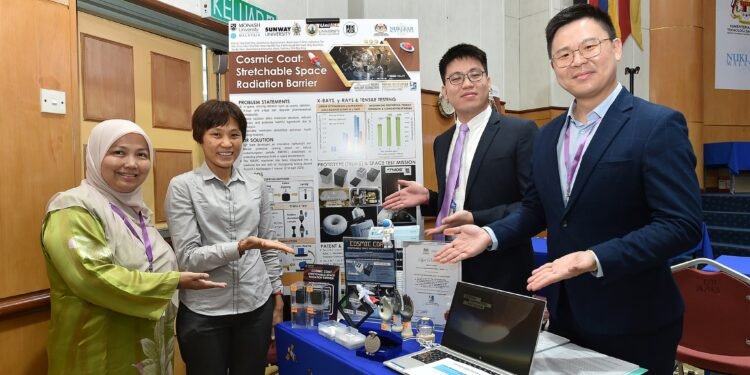
A Malaysian research team has developed a new radiation-shielding material that could help protect medicines and other sensitive biological materials from the harsh conditions of outer space.
Known as Cosmic Coat, the prototype is a flexible coating made from natural rubber infused with tungsten carbide. The researchers say the material could potentially shield pharmaceutical compounds from high-energy cosmic radiation during future missions to the Moon, Mars and beyond.
The project brings together researchers from Sunway University and Monash University Malaysia, with collaborators from IDDK, ATMOS Space Cargo, the Malaysian Nuclear Agency and Universiti Kuala Lumpur Malaysian Institute of Chemical & Bioengineering Technology.
The project is jointly led by Prof. Goh Bey Hing of the Sunway Biofunctional Molecules Discovery Centre (SBMDC), Faculty of Medical and Life Sciences, Sunway University, and Dr Patrick Tang Siah Ying of the Colloids and Polymers Group at Monash University Malaysia.
The research addresses a challenge that could become increasingly important as human spaceflight moves towards longer missions.

On Earth, the planet’s atmosphere and magnetic field provide substantial protection from cosmic radiation. Spacecraft, however, operate in an environment where high-energy particles from the Sun and distant stars can interact with materials and biological compounds.
For pharmaceuticals, prolonged radiation exposure can potentially alter chemical structures, reduce drug potency or produce unwanted degradation products. Maintaining the stability of medicines is therefore an important consideration for missions where astronauts may be far from Earth and unable to receive replacement supplies.
The Cosmic Coat team developed the material as a lightweight and flexible protective layer that can be applied to medicine containers, sample holders and other sensitive biological cargo.
The use of natural rubber is particularly significant for Malaysia, which has a long history of rubber production and technology.
According to the research team, Cosmic Coat represents the first reported use of natural rubber as the base material for cosmic radiation shielding. Tungsten carbide was incorporated into the rubber composite to enhance its radiation-shielding properties.
To test the concept beyond the laboratory, the researchers fabricated 3D-printed medicine containers and applied the coating using a precision dipping technique inspired by processes used in Malaysia’s glove-manufacturing industry.
The coated and uncoated containers were then incorporated into IDDK’s Micro Bio Space Lab, which was carried aboard the ATMOS Phoenix Space Capsule. The capsule was launched aboard a SpaceX Falcon 9 rocket on April 21, 2025. It orbited Earth for approximately two hours before returning to the atmosphere.
The flight provided the research team with an opportunity to expose the experimental materials and containers to the conditions of space and subsequently study their performance on Earth.
The experiment is described by the team as Malaysia’s first space-based pharmaceutical materials experiment, placing the country among researchers exploring the emerging field of Astropharmacy — the study of pharmaceutical stability, delivery and related challenges in space environments.
The next stage of the project will involve detailed post-flight analysis.
Researchers will compare medicines stored in Cosmic Coat-protected containers with those kept in uncoated containers. They will examine whether the coating helped preserve the chemical and physical stability of the medicines and assess its effectiveness against cosmic and secondary radiation.
The team will also examine the structural and mechanical condition of the coating after exposure to the vacuum, temperature fluctuations, and radiation associated with spaceflight.
These results will determine how the material might be improved and whether it could eventually have applications in longer-duration missions, lunar habitats and orbital research platforms.
The potential applications may extend beyond medicines.
The researchers say the coating could eventually be adapted to protect biological samples, radiation-sensitive equipment and delicate electronics in space. Similar radiation-shielding concepts could also have applications in certain terrestrial environments where sensitive materials require additional protection.
A patent application for the Cosmic Coat technology is currently in progress.
The project has already received recognition at several Malaysian innovation events. The team won a Gold Medal and Special Award in the Environment and Natural Resources category at Malaysian National Nuclear Innovation Day 2024.
It subsequently received a Silver Medal in the same category at Malaysian National Nuclear Innovation Day 2025 and another Silver Medal at the 7th SIRIM Invention, Innovation and Technology Expo 2025.
For the researchers, Cosmic Coat demonstrates how an established Malaysian material — natural rubber — can be combined with advanced materials science to address challenges associated with future space exploration.
The project also highlights the increasingly interdisciplinary nature of space research. Its development involves expertise spanning pharmaceutical research, molecular biology, polymer chemistry, materials science and aerospace technology.
For Malaysia, the experiment offers another example of how capabilities developed for terrestrial industries can be adapted to emerging challenges beyond Earth.
Whether Cosmic Coat can provide the level of protection required for long-duration space missions will depend on the results of the post-flight analysis. But the experiment has taken a distinctly Malaysian material — natural rubber — from a familiar Earth-based industry into an entirely new environment: space.
Adapted from The Japan Times.