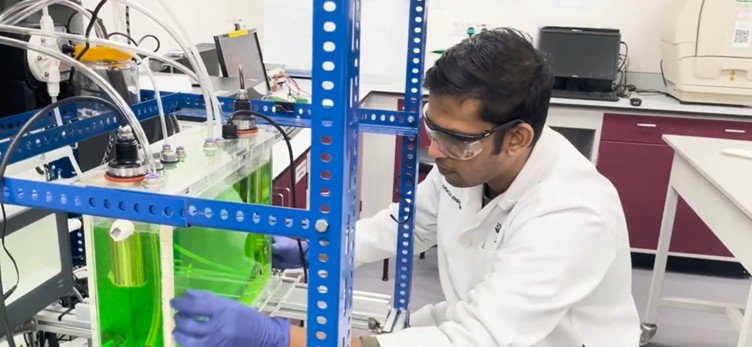
PhD student Manuja Dayanath works on the photobioreactor, part of the research aimed at developing sustainable biotechnology applications.
Climate change can sometimes feel like a problem too large and distant for ordinary people to grasp. But increasingly, it is showing up in everyday life — in hotter days, heavier rainfall, floods, changing weather patterns and growing pressure on food, water and energy.
For Malaysia and the rest of Southeast Asia, the question is no longer whether the region needs to respond to climate change. The question is how quickly and effectively it can do so.
Malaysia has set its sights on achieving net-zero carbon emissions by 2050. Reaching that goal will require much more than installing solar panels or replacing petrol cars with electric vehicles. It will require new materials, cleaner ways of producing energy, better use of agricultural waste, smarter energy systems and, importantly, solutions that work for the communities that use them.
This is where research can make a difference.

At Monash University Malaysia’s Centre for Net-Zero Technology (CNZT), researchers are approaching the challenge from several directions at once. Established in 2024 under the leadership of Professor Ir. Dr Chong Meng Nan, the centre brings together expertise across three interconnected areas: Advanced Energy Materials, Biotransformation, and Sustainable Urban Energy Solutions.
The idea is straightforward: solving a problem as complex as climate change requires more than one piece of the puzzle.
Building the technologies of tomorrow
The journey towards cleaner energy begins at a surprisingly small scale — sometimes at the level of individual atoms and molecules.
The materials used in clean-energy technologies can determine how efficiently they work, how long they last and whether they can eventually be produced at a cost people can afford.
At CNZT, the Advanced Energy Materials team, led by Associate Professor Ir. Dr Tan Lling-Lling, is developing new materials and processes for cleaner energy conversion.
One major area of research is green hydrogen.
Green hydrogen can be produced using renewable electricity to split water into hydrogen and oxygen through electrolysis. If the electricity comes from renewable sources, the process offers a potentially cleaner alternative to hydrogen production based on fossil fuels.
But producing green hydrogen efficiently is not as simple as splitting water.
The process requires catalysts — materials that help chemical reactions occur more efficiently. Researchers are therefore searching for catalysts that are highly active, durable and stable under demanding conditions.
The CNZT team is also exploring ways to convert captured carbon dioxide into useful carbon-based fuels and chemicals, as well as developing more sustainable approaches to ammonia production.
One study led by Mr Justin Khor found that introducing tin ions into a layered photocatalyst could increase solar-driven conversion of carbon dioxide to methane by 3.4 times. The research was published in Advanced Energy Materials.
Robotics and artificial intelligence are also entering the laboratory. Automated systems can carry out large numbers of experiments, while AI-based methods can help predict which materials are most promising.
This could significantly speed up the search for better materials for clean-energy technologies.
Turning waste into something valuable
The net-zero challenge, however, extends beyond how we produce energy. It also involves something much closer to everyday life: the enormous amount of agricultural biomass and organic waste produced across the region.
Agriculture contributes more than 8 per cent of Malaysia’s gross domestic product and more than 10 per cent across ASEAN, while generating large quantities of biomass residues and waste.
The question is what we do with all that material.
Rather than seeing agricultural waste as something to be discarded or burned, researchers at CNZT are asking whether it can become a resource.
This is the focus of the centre’s Biotransformation theme, led by Professor Wu Ta Yeong.
Biotransformation uses biological processes to turn biomass and other resources into useful products. Nature already does this remarkably well. Microorganisms and algae, for example, can transform one substance into another under relatively mild conditions.
Scientists are learning how to understand and improve these natural processes.
One example comes from a student-led team supervised by Associate Professor Saman Ilankoon.
The team developed a laboratory-scale flat-panel photobioreactor using microalgae. The system tackles two problems at once: it can help reduce carbon emissions from industrial flue gas while producing valuable nutraceutical products.
The invention won the fourth edition of the global Universities for Goal 13 competition organised by the United Nations and Siemens Energy. It also received a commendation from Professor Jeffrey Sachs, president of the UN Sustainable Development Solutions Network.
For a region producing enormous quantities of agricultural and organic waste, such approaches could open new possibilities.
Instead of treating biomass as something to throw away, it can become a feedstock for producing materials, chemicals and energy. This could reduce waste, lessen dependence on fossil-based resources and create opportunities for new low-carbon industries.
The goal is not simply to produce less waste.
It is to stop thinking of waste as waste in the first place.
Making energy work for people
But even the best new material or biological process will remain largely confined to a laboratory unless it can work in the real world.
That is the focus of CNZT’s third research theme, Sustainable Urban Energy Solutions, led by Dr Tan Wen Shan.
Cities are major consumers of energy and are therefore central to the energy transition. But renewable sources such as solar power are variable. The sun does not shine all day, while electricity demand changes from hour to hour.
Future energy systems therefore need to become smarter and more flexible.
The challenge is particularly relevant to Malaysia and Southeast Asia, where rapidly developing cities exist alongside rural and remote communities, and where tropical conditions create their own energy demands.
Solutions developed elsewhere cannot simply be copied. They have to be adapted to local conditions and, ultimately, to the people who use them.
One example is eCOS, an innovative digital control system developed by Dr Tan Wen Shan in collaboration with AmSolar Sdn. Bhd.
The system integrates solar photovoltaic panels with battery energy storage and intelligently manages the flow and use of electricity. It has been shown to reduce energy costs for consumers by up to 20 per cent.
The project won the 2024 Sustainable Energy Development Authority (SEDA) Innovation Challenge.
This is where the net-zero conversation becomes tangible.
It is no longer simply about reducing tonnes of carbon dioxide on a graph. It is about whether households and businesses can use cleaner energy, whether electricity costs can be reduced and whether energy systems remain reliable as conditions change.
From the laboratory to the real world
Research does not end when an experiment produces a promising result.
For clean-energy technology to make a real difference, it must leave the laboratory, survive real-world conditions, be scaled up and become economically viable.
That requires partnerships.
CNZT works with government agencies, industry partners and international collaborators to move promising ideas towards practical application.
One example is its collaboration with PETRONAS Research Sdn. Bhd., led by Professor Chong Meng Nan, to advance a commercially scalable, solar-driven capillary-fed proton exchange membrane (PEM) electrolyser for green hydrogen production.
Such partnerships allow researchers to understand the problems industry faces while giving promising technologies a pathway towards testing, scale-up and eventual commercial use.
Industry brings practical experience and real-world challenges; universities bring scientific knowledge, experimentation and new ideas.
That connection will be essential if ASEAN is to move from climate ambitions to measurable results.
NOTE: This article was rewritten from the original by Dr Joshua Zheyan Soo and Prof. Ir. Dr Meng Nan Chong