
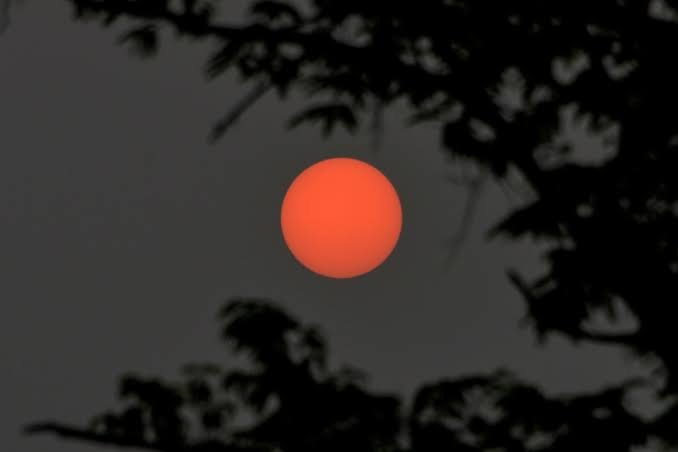
One evening, as I was returning home from university on the LRT, I looked out the window and noticed something unusual. The Sun looked orange-red, almost like a ball of fire in the sky.
At first, I found it quite beautiful. It was not the usual golden Sun I was used to seeing. But as I looked, I started wondering why it looked so different. Was something happening to the Sun, or was it because of the haze Malaysia has been experiencing?
The answer is actually quite interesting. The Sun itself has not changed. Instead, the haze in the atmosphere is changing how its light reaches our eyes.
Why does the Sun look red?
Sunlight may look white to us, but it contains different colours, including red, orange, yellow, green and blue. Each colour has a different wavelength. Blue light has a shorter wavelength, while red light has a longer one.

When sunlight enters the Earth’s atmosphere, it interacts with air molecules and tiny particles. Blue light is scattered more easily by air molecules than red light. This process is called Rayleigh scattering, and it is one of the reasons the sky appears blue during the day.
However, the situation changes when there is haze.
Haze contains tiny particles from sources such as smoke, dust and burning vegetation. These particles interact with sunlight through scattering and absorption. Depending on their size and concentration, they can change the amount and colour of light reaching our eyes.
As sunlight passes through hazy air, some of the shorter-wavelength light may be scattered away from the direct beam. This can make the remaining sunlight appear more yellow, orange or red.
In simple terms, imagine sunlight as a mixture of colours travelling together. When it passes through haze, some colours are redirected or absorbed more than others. The light that finally reaches our eyes can therefore look different.
Why does it also happen during sunset?
You may have noticed that the Sun often looks orange or red during sunset, even when there is no obvious haze.
This happens because sunlight travels through a longer distance in the atmosphere when the Sun is close to the horizon. More of the shorter-wavelength light is scattered away before the direct sunlight reaches us.
Haze can make this effect more noticeable because it adds more particles to the atmosphere.
This explains why the Sun I saw through the LRT window looked so red. The combination of sunlight passing through the atmosphere and the particles present in the hazy air changed its appearance.
The Sun was not becoming hotter or burning differently. It was simply the way its light was travelling through the atmosphere.
What is actually in the haze?
Although the red Sun can look beautiful, the haze itself is a concern.
Haze can contain smoke, dust and fine particulate matter. One important type is PM2.5, which refers to particles that are 2.5 micrometres or less in diameter. These particles are so small that they can travel deep into our lungs.
Exposure to haze can cause eye irritation, coughing and throat discomfort. It can also worsen asthma and other existing respiratory conditions. People with heart or lung diseases, older adults and children may be more vulnerable to its effects.
The worrying part is that we cannot always see how polluted the air is just by looking at the sky.
A very red Sun does not automatically mean the air is more dangerous, and a sky that looks clear does not necessarily mean the air is clean. The colour of the Sun depends on several factors, including the amount and type of particles in the atmosphere and the position of the Sun.
This is why checking Malaysia’s Air Pollutant Index (API) is important during haze episodes. It gives us a better indication of air quality than simply looking at the sky.
Why does haze keep returning to Malaysia?
Haze is not a new problem for Malaysia. It has affected the country repeatedly, sometimes causing poor air quality, reduced visibility and disruptions to outdoor activities.
Regional haze can be linked to vegetation and peatland fires, including fires in neighbouring Indonesia. Smoke can travel over long distances, meaning that pollution produced in one area can affect people in another country.
Dry weather can also make fires more likely to spread and persist.
Preventing open burning, managing land responsibly and improving cooperation between neighbouring countries are important steps in reducing the problem. Although individuals can take precautions, such as checking the API and limiting outdoor activities when air quality is unhealthy, tackling haze also requires action from authorities and industries.
What can we learn from the red Sun?
Looking at the Sun through the LRT window made me curious about something I might otherwise have ignored. I had seen the Sun countless times, but that evening, its unusual colour made me stop and ask why.
The explanation comes from a simple scientific idea: light changes direction when it interacts with particles in the atmosphere. However, the same haze that changes the appearance of sunlight can also affect the air we breathe.
The next time we see a red Sun in Malaysia, it is worth remembering that the colour itself does not tell us exactly how polluted the air is. Checking the air quality is much more useful than judging it by appearance alone.
For me, that evening was a reminder that science is not only something we learn in lecture halls or laboratories. Sometimes, it begins with looking out of an LRT window, noticing something unusual and asking a simple question: why does the Sun look different today?
About the Author: Safia Rahim Rabata is studying Medical Biotechnology at Sunway University. She is participating in The Petri Dish Fellowship Writing Lab.