Sarawak is seeking to accelerate the transition from research findings to real-world applications, with its Centre of Excellence (CoE) for Digital Research highlighting translational research as a key priority at its inaugural conference.
The Centre of Excellence for Digital Research Conference 2026, held as part of the ninth International Digital Economy Conference Sarawak (IDECS26), brings researchers, universities, government agencies and industry partners together to strengthen pathways for research to move beyond academic publication and into technology development, public services and commercial use.
The effort is supported by RM26 million in translational research funding and an existing research portfolio comprising 357 multidisciplinary and interdisciplinary projects, 258 research publications, 55 intellectual property outputs and 146 postgraduate researchers.
For Sarawak, the challenge is now to convert this research capacity into technologies and solutions that can be tested, validated and adopted outside the research environment.
Opening the conference, Deputy Minister for Education, Innovation and Talent Development I (Education and Innovation) Sarawak, Dr Annuar bin Rapaee, represented Minister Dato Sri Roland Sagah Wee Inn.

In his special address, Sagah said Sarawak needed to develop its own technological capabilities rather than remain primarily a consumer of technologies developed elsewhere.
“If Sarawak is to participate meaningfully in increasingly technology-driven industries, we cannot be only users of technologies developed elsewhere. We must also build the capability to understand them, improve them and develop solutions of our own,” he said.
He said this would allow more knowledge, intellectual property and technical capability to be generated within Sarawak.
From research to validation
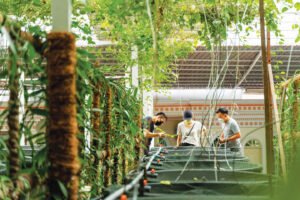
The conference showcases research aimed at addressing practical challenges, including cancer risk awareness, precision irrigation, and municipal waste forecasting and collection routing.
Such projects illustrate the role of translational research, where scientific and technical findings are developed further so they can be evaluated in operational settings and eventually adopted by users.
The CoE’s OpenLab, testbeds and living labs provide environments where researchers can develop, test and refine technologies. These facilities are intended to help bridge the gap between research and deployment by allowing technologies and research solutions to be evaluated under more realistic conditions.
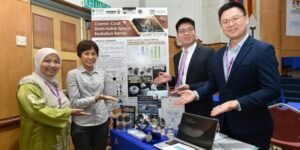
The CoE Pavilion provides another link between researchers, industry and government, creating opportunities to discuss joint research, technology validation and potential adoption.
Five spin-off ventures emerging from CoE-supported research are also featured at the Pavilion, demonstrating how research outputs can progress towards commercialisation.
Building a connected research ecosystem
The CoE research network includes six Sarawak-based university partners and five external university partners, including Universiti Malaya, the National University of Singapore, the University of Canterbury, the University of New South Wales and the University of Melbourne.
The partnerships provide opportunities for researchers to share expertise, develop research capacity and pursue collaborative projects across institutions and disciplines.
Research areas represented within the ecosystem include digital health, advanced manufacturing and semiconductors, smart cities, green energy and energy transition, space, advanced mobility, food security, future society and cybersecurity.
The breadth of these areas reflects the increasingly interdisciplinary nature of technology research, where advances in one field can contribute to solutions in another.
Professor Jugdutt “Jack” Singh, Chief Scientist and Chief Advisor for Digital Economy and chairman of the CoE Steering Committee, is addressing how research institutions can develop a more connected ecosystem capable of supporting sustained collaboration and technology adoption.
The conference also provides academic tracks for researchers and postgraduate students to present their findings, exchange ideas and identify potential collaborators.
A series of Memoranda of Understanding exchanged during the conference further supports collaboration in research, talent development and industry engagement.
For Sarawak’s research ecosystem, the emphasis is increasingly shifting from what can be discovered to what can be developed, tested and put to use.