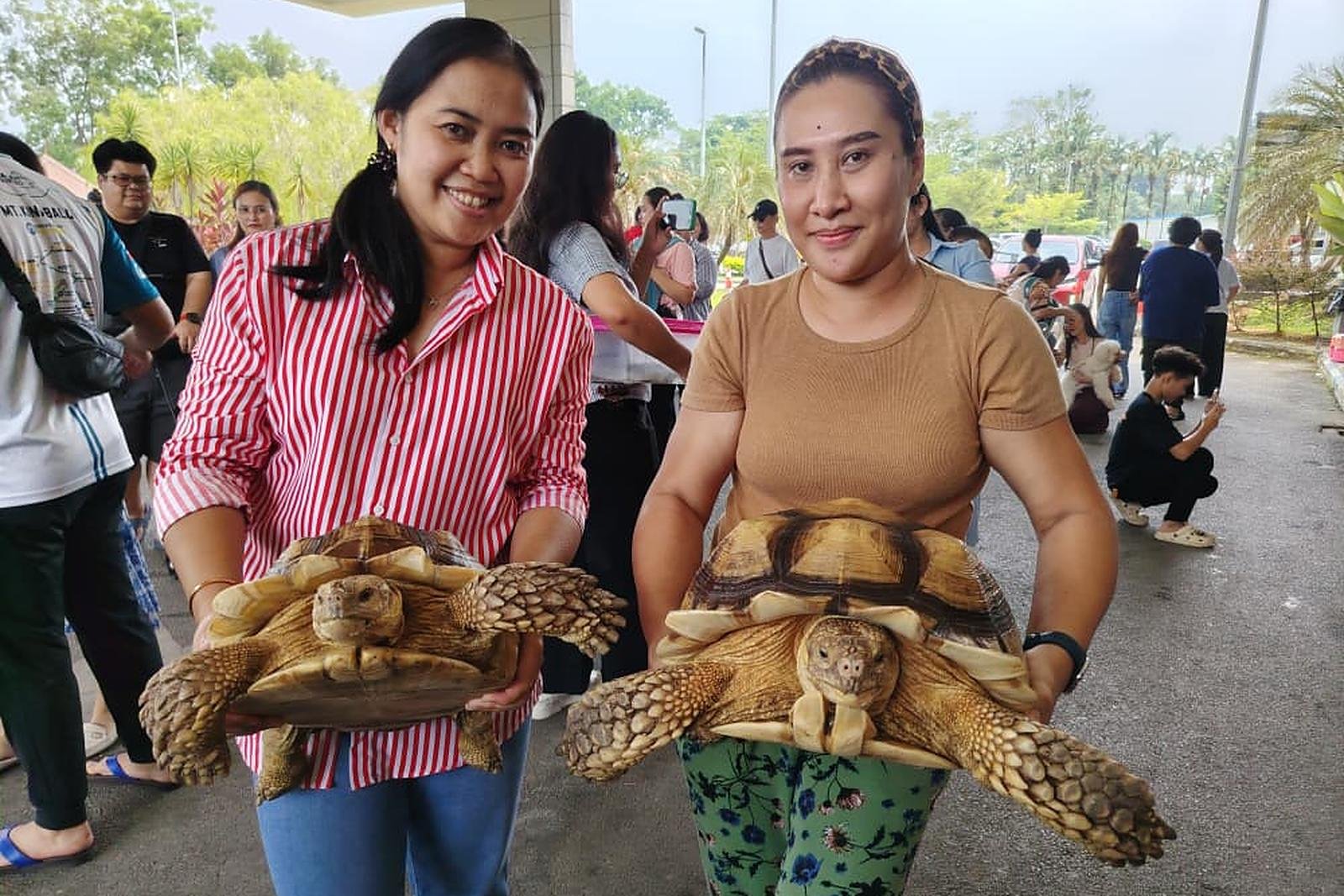
Sisters Anne Patrick (left) and Saint Hermione Patrick pose with their Sulcata tortoise pets, Heng Heng and Chaisen, during the pet blessing at St Anne’s Church. The African spurred tortoises were among the more unusual visitors at the event, attracting attention with their distinctive shells and gentle nature. Despite their quiet appearance, Sulcatas can grow into large reptiles weighing up to 90 kilograms and live for 70 years or more. Photo by Marilyn Madrod
Two African Sulcata tortoises unexpectedly became the stars of an animal blessing at a Catholic parish in Malaysian Borneo, drawing curious parishioners who had come with dogs, cats, rabbits, birds, fish and other pets.
The tortoises, named Heng Heng and Chaisen, were brought to St. Anne’s Church on Oct. 4, the patron day of St. Francis of Assisi, a saint revered for his love of creation, the natural environment and God’s creatures.
Their unexpected appearance at the parish blessing also caught the attention of The Petri Dish, offering an opportunity to look beyond the novelty and learn more about these remarkable African reptiles — their origins, biology, distinctive adaptations and what makes the Sulcata tortoise one of the world’s most interesting land tortoises.
From tiny tortoise to desert giant

The African spurred tortoise (Centrochelys sulcata) is the largest mainland tortoise species.
Native to the dry grasslands, savannas and shrublands along the southern edge of the Sahara and across the Sahel, it is found in parts of Africa including Senegal, Chad and Sudan.
It is built for an environment where heat, drought and scarce vegetation are part of everyday life. The sandy or yellowish-brown shell provides camouflage against the dry landscape, while its powerful legs allow it to travel across difficult terrain.
The animal gets its common name from the prominent spurs on its hind legs.
But its most impressive equipment is its digging ability. A sulcata can use its strong front legs to excavate deep burrows, sometimes several metres into the ground.
For an animal living in an extremely hot environment, the burrow is not simply a comfortable place to rest. It is a survival tool.
Temperatures underground can be considerably more stable than those on the surface, allowing the tortoise to escape extreme heat and, when necessary, colder conditions.
In the wild, a sulcata’s ability to dig can mean the difference between surviving and succumbing to the harsh environment. In a garden, however, the same instinct can become a problem.
The escape artist in the backyard
Anyone thinking of keeping a sulcata should understand one thing about its personality. It digs. And it is very good at it.
A tortoise that looks slow and harmless can be surprisingly strong. Given enough time, it can dig beneath fences and create an escape route.
That means ordinary garden fencing may not be sufficient for an adult animal.
The enclosure has to be designed with the tortoise’s strength and digging behaviour in mind.
This is one reason the animal’s small size as a hatchling can be misleading.
A young sulcata may fit comfortably into a small enclosure. An adult one may not.
Males can reach around 75 to 90 centimetres in shell length and weigh roughly 45 to 90 kilograms, although individual sizes vary. Females are generally smaller.
In other words, the little tortoise that can sit comfortably in your hand today could eventually become a 50- to 90-kilogram animal occupying a substantial part of your garden.
That is a very different proposition from keeping a small terrapin.
A vegetarian with specialised needs
The sulcata may be large, but it does not need a diet of meat. It is a herbivore, feeding mainly on grasses and other vegetation.
A high-fibre diet is important, reflecting the tough, fibrous plants available in its natural environment. Captive animals therefore need an appropriate diet based largely on grasses, hay and suitable weeds and plants.
Feeding an exotic animal simply because it appears to enjoy a particular food can be dangerous. Too much fruit or inappropriate high-protein food can contribute to health problems and abnormal shell development.
The distinctive shell is more than an attractive feature. It is living tissue and part of the tortoise’s skeletal structure. Poor nutrition during growth can result in abnormal development, including pyramiding, where the scutes develop raised, pyramid-like shapes instead of the smoother appearance associated with healthy growth.
A pet that may outlive you
Perhaps the biggest commitment involved in keeping a sulcata is not its size. It is time.
These tortoises can live for 70 years or more, with some reported to reach beyond 100 years under suitable conditions. That means owning one is potentially a commitment spanning generations.
The person who buys a young sulcata today may not be the person caring for it when it reaches full size. This is something that can easily be overlooked when people encounter a small, attractive tortoise at a pet shop or see one being kept by someone else.
The reality becomes very different when the animal grows.
A mature sulcata requires adequate space, suitable shelter, proper nutrition and, depending on the climate and housing arrangement, appropriate heat and ultraviolet light. It also needs an enclosure that can withstand an animal that is both strong and determined.
In warm climates, outdoor conditions may be suitable for much of the year, but that does not mean the tortoise can simply be left in a garden.
It still needs protection, proper food, access to suitable shelter and veterinary care when necessary.
Not every tortoise should become a pet
The popularity of exotic pets also raises a conservation question.
The African spurred tortoise is listed under Appendix II of the Convention on International Trade in Endangered Species of Wild Fauna and Flora, or CITES. International trade is regulated to ensure that it does not threaten wild populations.
That makes the source of a pet important.
The owners of Heng Heng and Chaisen, sisters Saint Hermione Patrick and Anne Patrick, told The Petri Dish that they purchased the tortoises from a pet shop and have complied with the requirements to keep them as pets.
For Heng Heng and Chaisen, their appearance at the pet blessing was more than an unusual sight. It offered a glimpse into the fascinating world of a species that may look slow and simple, but is remarkably well adapted to survive — and thrive — for decades.
Wild animals should never be taken from their natural habitats simply to satisfy the demand for exotic pets.
A responsibly captive-bred tortoise is a very different proposition from one that has been illegally collected from the wild.
Potential owners should also consider whether they are prepared for the animal they will have in 10, 20 or 50 years.
The problem with some exotic pets is not that people do not like them. People underestimate what those animals eventually become.
More than a photo opportunity
Back at St Anne’s, the sulcatas may have been among the most unusual animals at the blessing. They were certainly among the quietest.
But their presence offered something more than a memorable photograph. It provided a glimpse into a fascinating example of adaptation.
The sulcata has evolved to survive in some of Africa’s harshest landscapes. Its shell protects it, its powerful legs let it travel and dig, its plant-based diet uses tough vegetation, and its underground burrows help it cope with temperature extremes.
Those same characteristics are what make it such a demanding animal to keep in captivity. The lesson is simple. A wild animal does not become an easy pet simply because it can live alongside humans.
The sulcata may look peaceful and even charming as it sits quietly among a crowd of dogs and cats.
But behind that calm exterior is a desert survivor with powerful legs, an appetite for grass, a talent for excavation and potentially a century of life ahead.
So the next time one turns up at a pet blessing, it may be worth looking beyond its unusual appearance. That small tortoise is carrying an extraordinary piece of African natural history on its back.