Imagine a surgeon performing an operation. The surgical area may be only a few centimetres wide, yet it contains tiny blood vessels, nerves, muscles and other structures that must be seen clearly. Now imagine the surgeon’s hand or an instrument moving over the area and blocking the light.
A dark shadow could appear exactly where the surgeon needs to see.
This is why the lights used in operating theatres are very different from ordinary lamps. Surgical lights are specially designed to provide bright, uniform illumination while minimising shadows. They help surgeons see the operating field clearly even when their hands, instruments or other objects are between the light and the patient.
But how is this achieved?
Why are shadows a problem?
A shadow forms when an object blocks light travelling from a light source. This is easy to observe in everyday life. Place your hand under a lamp and a shadow appears on the surface below.

During surgery, however, shadows can make it more difficult to see important details. A surgeon may need to distinguish the colour, texture and shape of tissue, or identify a tiny blood vessel. If part of the surgical field is covered by a dark shadow, these details can become harder to see.
Surgeons also work with their hands and instruments very close to the operating area. If the light came from only one direction, these objects could easily block the light.
The solution is to make sure that light reaches the surgical field from multiple directions.
Multiple light sources
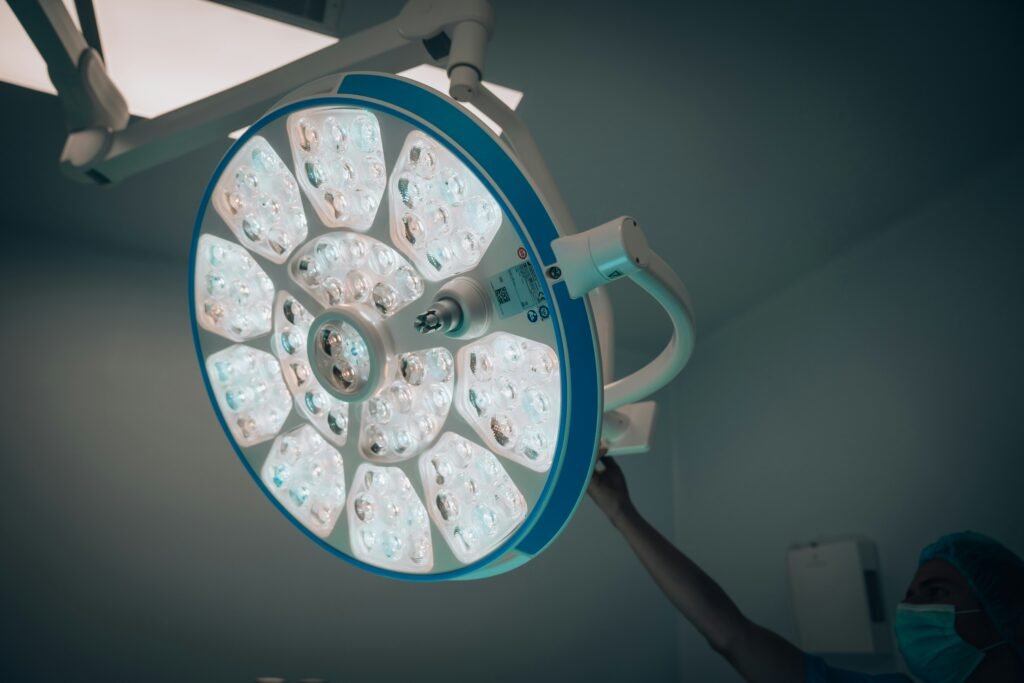
Modern surgical lights contain multiple light-emitting sources, commonly LEDs, arranged within the light head.
Instead of having one bulb shining directly downwards, the individual light sources illuminate the surgical field from different angles.
Think about standing outside on a sunny day. The Sun is essentially one major light source, so your body can produce a strong shadow. Now imagine several lamps positioned around you. If one lamp is blocked by your body, the others can still illuminate the area.
Surgical lights work on a similar principle.
When a surgeon’s hand blocks light coming from one direction, light from other sources can still reach the area. The shadow is therefore reduced or softened rather than becoming completely dark.
Technically, surgical lights are not truly “shadowless”. They are designed to minimise and fill in shadows.
Cross-focused lighting
The different light sources are carefully positioned so that their beams overlap at the surgical site. This is sometimes described as cross-focused or multi-directional illumination.
Suppose an object blocks light from one source. It may create a shadow in one direction. However, light arriving from another source can illuminate that same area.
The overlapping beams therefore help fill in shadows created by the surgeon’s hands, instruments or other objects.
This is a simple application of optics, but it is extremely important in the operating theatre.
Why LEDs are useful
Modern surgical lights commonly use light-emitting diodes, or LEDs.
LEDs can produce intense illumination while using relatively little electrical power. They are also compact, which allows many individual light sources to be arranged within a single light head.
Another important advantage is heat. Traditional light sources can produce considerable heat along with visible light. Excessive heat is undesirable in an operating theatre because the surgical team works close to the light and operations can last for several hours.
LED technology allows surgical lights to provide bright illumination while producing relatively little unwanted heat.
The LEDs can also be carefully positioned and controlled to create an even pattern of illumination across the surgical field.
Reflectors direct the light
Having many light sources is not enough. The light also needs to be directed precisely. This is where reflectors and other optical components are important.
A reflector changes the direction in which light travels. In a surgical light, carefully designed optical systems help direct the light towards the operating area.
Rather than allowing light to spread randomly, these systems help concentrate illumination where it is needed.
Diffusers improve uniformity
Surgical lights may also use diffusers, which help distribute light more evenly across the operating field.
Uniform illumination is important because surgeons need to distinguish subtle differences in tissue. Uneven lighting could produce areas that are excessively bright or dark, making it harder to interpret what they see.
The combination of LEDs, reflectors and diffusers therefore helps create a broad and relatively uniform area of illumination.
The lights can be positioned
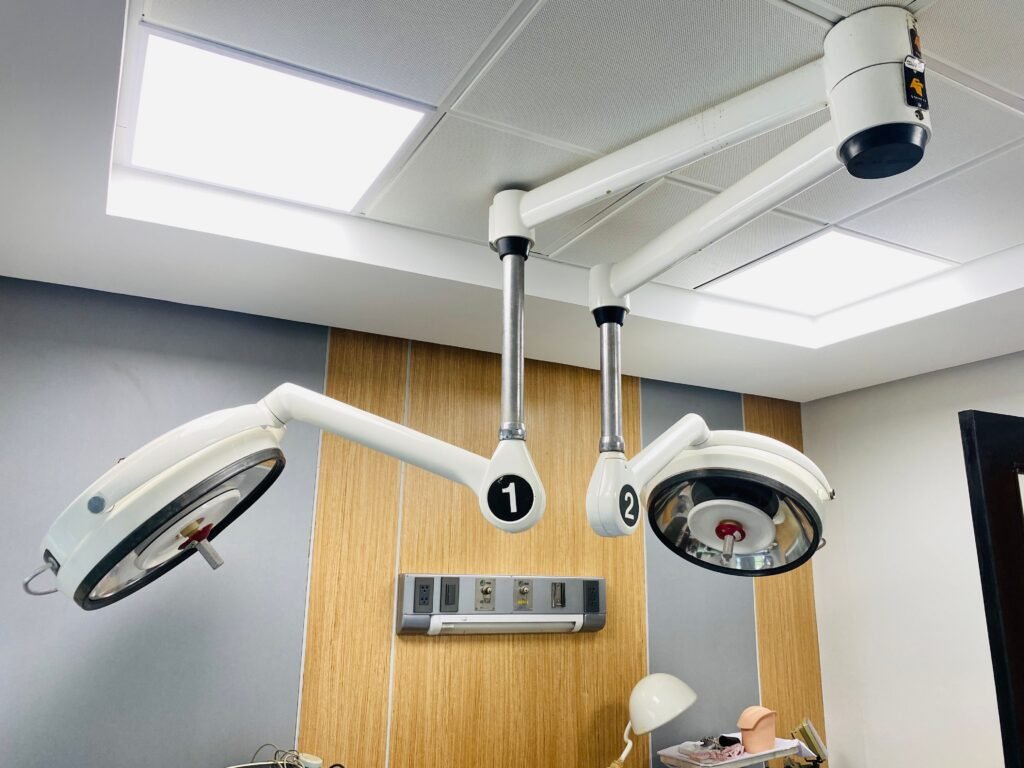
You may have noticed that surgical lights are attached to movable arms. This allows surgeons and other members of the surgical team to adjust the position and angle of the lights.
This is important because the position of the surgeon, assistants and instruments constantly changes during an operation.
Some operating theatres use more than one large surgical light head. These can be positioned at different angles to provide additional illumination and further reduce shadows.
Brightness is not everything
It might seem that the brighter the light, the better the surgeon can see. However, surgical lighting is more complicated than simply increasing brightness.
Too much light can produce glare and discomfort. What matters is not just intensity, but also the direction, uniformity and quality of the illumination.
Surgical lights are therefore carefully engineered to provide strong illumination while reducing glare and unwanted shadows.
From simple shadows to advanced technology
A surgical light may look like a simple lamp, but it is actually a sophisticated combination of physics, optics, electronics and engineering.
Multiple light sources provide illumination from different directions. Reflectors and optical components direct the light, while diffusers help distribute it evenly. Adjustable light heads allow the surgical team to position the illumination where it is needed.
Together, these technologies solve a basic problem: how can we see clearly when objects are constantly getting in the way of the light?
The answer is not to eliminate shadows completely. Instead, surgical lighting uses many carefully controlled sources of light so that when one source is blocked, others can illuminate the area.
It is a good example of how understanding a simple scientific phenomenon, the formation of shadows, can lead to sophisticated technology that supports one of the most demanding environments in modern medicine.