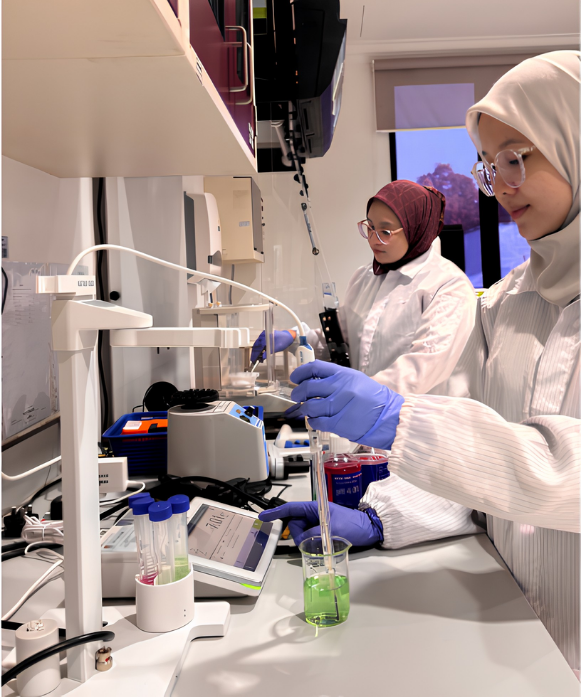
Innovation is moving rapidly from laboratories into the marketplace. New medical devices, cosmetics, supplements, pharmaceuticals, food products, agrochemicals, biomaterials and research prototypes are being developed and commercialised at an increasing pace. But before an innovation reaches consumers, patients, or other end-users, one question
must be answered: Is it safe?
Product safety assessment is more than a regulatory requirement. It is a scientific process that identifies potential biological risks, supports product development and provides evidence for regulators, industry partners, researchers and the public.
Depending on the product and its intended use, safety assessment may involve tests for cytotoxicity, irritation, sensitisation, systemic toxicity, genotoxicity, acute toxicity, heavy metals and microbiological contamination, among others.
For industry, such assessments can support product registration, quality assurance, risk management and market readiness. For researchers, they can help move discoveries from the laboratory towards collaboration, commercialisation and real-world application.
A product may perform well in an early laboratory experiment, but that does not necessarily mean it is ready for use in people, animals or the environment. Safety testing helps fill this gap by providing evidence about how a product may behave in biological systems.

Think about safety early
Researchers should not consider safety only when a product is almost ready for commercialisation.
At the laboratory bench, researchers are often focused on whether a new material, extract, formulation, prototype or biological discovery works. An equally important question is whether it can eventually be developed safely.
This does not mean every early-stage research project needs a full regulatory testing programme. Instead, researchers should begin asking basic questions early.
What is the product intended to do? Who or what could be exposed to it? Will it come into contact with skin, tissue, blood, cells, animals or humans? Could it enter a food system or the environment? What potential biological risks need to be investigated?
Considering these questions early can help researchers design more appropriate studies and identify safety concerns before significant resources are invested in further development.
It can also prevent a common problem in innovation: a scientifically promising discovery that lacks the safety evidence needed to move to the next stage.
Understanding the role of toxicology
Toxicology provides an important scientific foundation for product safety assessment.
The principle commonly associated with Paracelsus — that “the dose makes the poison” — remains relevant. A substance cannot be considered simply safe or harmful without considering factors such as dose, route of exposure, duration and biological context.
Even substances that are useful in medicine, industry or natural products can cause harmful effects when exposure occurs at inappropriate levels or under unsuitable conditions.
Toxicology therefore goes beyond simply asking whether something is toxic. It examines potential biological effects and helps researchers understand the relationship between exposure, dose and response.
This information can support decisions about whether a material, formulation, extract or device is suitable for its intended application and what risks may need to be managed.
Why laboratory quality matters
The reliability of a safety assessment depends not only on the test itself, but also on the competence and quality systems of the laboratory conducting it.
ISO/IEC 17025 is an internationally recognised standard for the competence of testing and calibration laboratories. Accreditation demonstrates that a laboratory operates under a quality system and has the technical competence to produce reliable and traceable results.
This includes areas such as personnel competence, equipment control, test methods, quality assurance, documentation and reporting.
For non-clinical safety studies, OECD Good Laboratory Practice (GLP) provides another important framework. GLP focuses on the integrity of studies through proper planning, documentation, quality assurance, data traceability and transparent reporting.
Together, these frameworks help provide confidence that safety data have been generated through controlled and scientifically accountable processes.
Relevant across industries
Product safety assessment is relevant to a wide range of sectors.
Medical device developers may require biocompatibility testing to understand how a device interacts with the human body. Cosmetic and supplement companies may need safety and quality assessments to support product development and market confidence.
Pharmaceutical, food, agrochemical and biotechnology companies may also require toxicity or other biological safety assessments depending on the nature and intended use of their products.
The same principle applies to academia. Safety assessment should not be viewed solely as an industry or regulatory requirement. Early safety screening can strengthen research quality and help prepare discoveries for future grants, publications, industry partnerships, commercialisation and translation.
A proactive approach
The most effective time to consider safety is not at the end of product development, but during the planning process.
Early discussions with a suitably qualified testing laboratory can help researchers and companies identify the information required, determine which tests may be relevant and integrate safety assessment into the wider development pathway.
This can help avoid unnecessary delays, reduce the risk of repeated testing and allow resources to be planned more efficiently.
Ultimately, safety assessment should not be regarded as an obstacle to innovation. It is part of responsible innovation.
A scientifically promising product becomes more valuable when its potential risks are understood and managed. By considering safety from the laboratory bench onwards and generating reliable evidence through competent testing, researchers and companies can build a stronger pathway from discovery to development and, ultimately, to real-world use.
NOTE: Dr Siew Ee Ling is a Senior Lecturer with the ASASIPintar Programme, Pusat PERMATA@Pintar Negara, Universiti Kebangsaan Malaysia (UKM), and Laboratory Director of Makmal Bioserasi ALAF-UKM, UKM.